
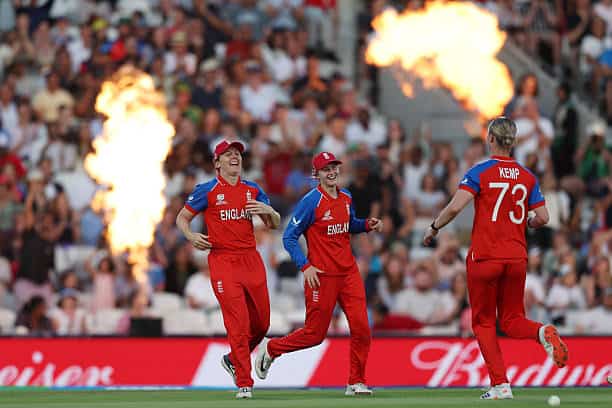
England moved one step closer to another home World Cup triumph after defeating South Africa by 40 runs in the second semi-final of the ICC Women’s T20 World Cup 2026 at The Oval.
The hosts reached 169 for 5 before restricting the Proteas to 129 for 8, setting up a blockbuster final against six-time champions Australia at Lord’s on July 5.
Nat Sciver-Brunt marked her return from a calf injury with a match-winning 75 from 47 deliveries. Her composed innings rescued England from a difficult start and earned her the Player of the Match award.
The victory carried England into their fifth Women’s T20 World Cup final and extended their unbeaten run in the tournament.
Sciver-Brunt Returns For Knockout Clash
England received a major boost before the semi-final when regular captain Sciver-Brunt returned to lead the side.
She replaced Sophia Dunkley in the playing XI after recovering from the calf problem that had created uncertainty over her availability.
South Africa also made a change, bringing Sune Luus back into the team in place of Dane van Niekerk.
Despite doubts surrounding her fitness, Sciver-Brunt delivered one of the finest performances of her career under pressure.
The 33-year-old came in at No. 3 and struck 11 fours and one six during her 75. It became the highest individual score by an England captain in the knockout stages of the Women’s T20 World Cup.
South Africa Put England Under Early Pressure
England were immediately tested by South Africa’s new-ball attack.
Marizanne Kapp and Shabnim Ismail found early movement and reduced the hosts to 35 for 3 inside the powerplay.
With the top order dismissed and the innings in danger of collapsing, Sciver-Brunt joined former captain Heather Knight at the crease.
The pair initially focused on surviving the difficult conditions before gradually increasing the scoring rate.
Their experience allowed England to rebuild without allowing the required acceleration to become impossible later in the innings.
Record Partnership Transforms The Innings
Sciver-Brunt and Knight added 133 runs, the highest partnership recorded in a knockout match in Women’s T20 World Cup history.
Knight contributed 58 from 47 balls, providing crucial support while Sciver-Brunt took greater control of the scoring.
Their partnership combined patience with calculated aggression and completely changed the direction of the semi-final.
England recovered from 35 for 3 to finish with a competitive 169 for 5, placing significant scoreboard pressure on South Africa.
Nonkululeko Mlaba and Ismail both claimed two wickets, while Kapp finished with economical figures of 1 for 16 from four overs.
Sciver-Brunt Adds More Knockout Records
Sciver-Brunt’s innings was significant on several levels.
Her 75 became the second-highest score by any captain in a Women’s T20 World Cup knockout match, behind former New Zealand skipper Aimee Watkins.
It also ranked as the second-highest knockout score by an England batter in the competition, behind Claire Taylor.
Sciver-Brunt now has 169 runs in the 2026 tournament at an average of 84.50 and a strike rate of 159.43 from three innings.
Across her Women’s T20 World Cup career, she has accumulated 907 runs from 30 innings at an average of 43.19 and a strike rate of 123.06.
The numbers underline her consistency and ability to deliver in the most important matches.
South Africa Begin Chase Strongly
South Africa made a steady start through Laura Wolvaardt and Tazmin Brits.
The opening pair kept the Proteas in contention during the powerplay, but England regained control when Linsey Smith dismissed Wolvaardt at the end of the sixth over.
Brits continued to resist and completed a determined half-century, but the increasing required rate placed greater pressure on the middle order.
Her innings of 51 ended when Charlie Dean provided another crucial breakthrough.
Once Brits was dismissed, South Africa struggled to maintain the pace required to challenge England’s total.
England Bowlers Close Out Victory
England’s attack shared the responsibility effectively throughout the defence.
Lauren Bell, Smith, Dean, Sophie Ecclestone and Freya Kemp combined to prevent South Africa from building another major partnership.
The Proteas eventually finished on 129 for 8 from their 20 overs, falling 40 runs short of the target.
Their defeat ended hopes of reaching a third consecutive Women’s T20 World Cup final.
It also allowed England to avenge semi-final losses against South Africa at the 2023 T20 World Cup and the 2025 ODI World Cup.
Australia Await At Lord’s
Australia had already secured their place in the final after defeating West Indies by eight wickets in the first semi-final on June 30.
Led by Sophie Molineux, the defending champions will now appear in their eighth Women’s T20 World Cup final and attempt to win a seventh title.
England, meanwhile, will enter the contest with home advantage, an unbeaten record and renewed confidence following the return of their captain.
The final at Lord’s brings together two of the strongest teams in women’s cricket and renews one of the sport’s greatest rivalries.
Sciver-Brunt’s semi-final innings was more than a successful return from injury. It was a statement of leadership from England’s most important player at a decisive stage of the tournament.
With a place in the final secured, England are now one victory away from lifting the trophy on home soil.
