
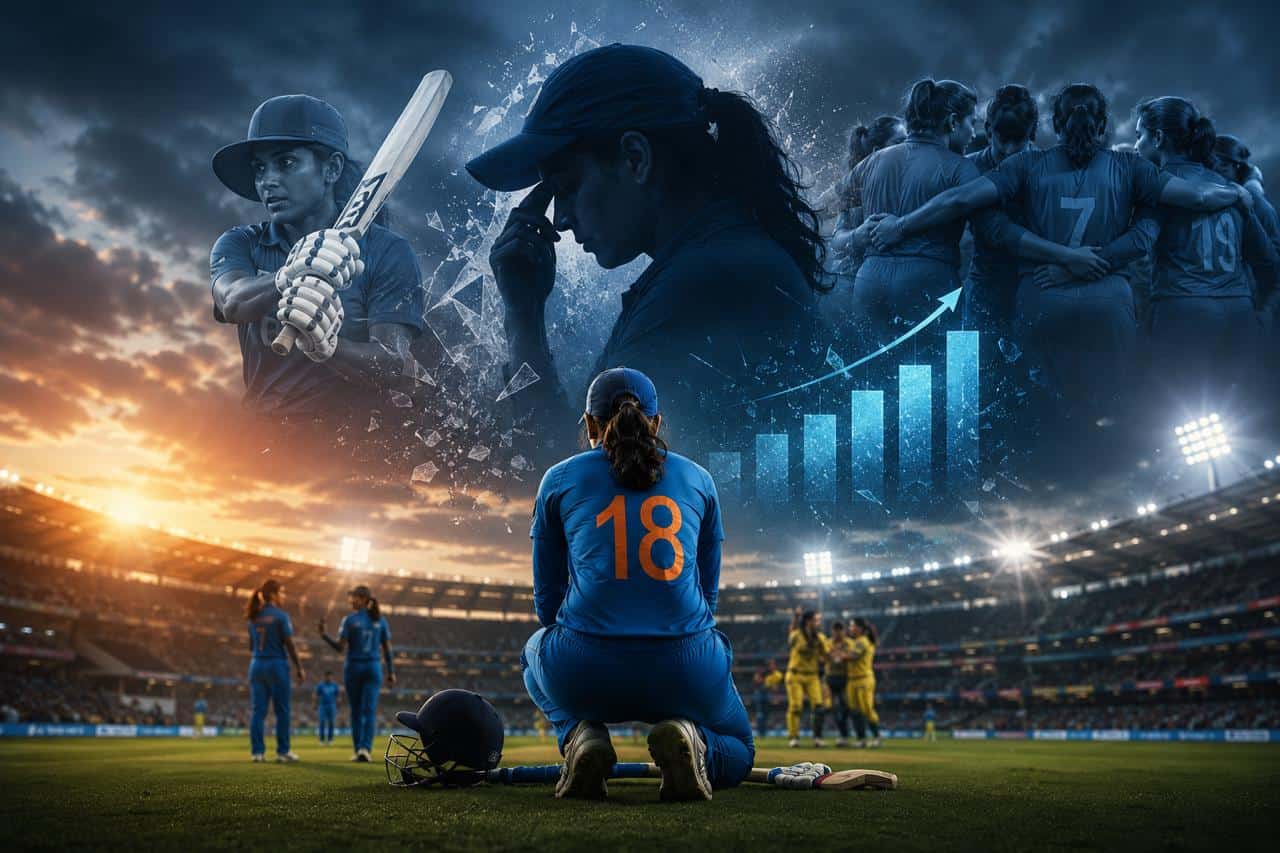
Over the last decade, the India Women’s cricket team has grown into one of the strongest teams in world cricket. They have reached several finals and semifinals across major tournaments and have produced some unforgettable performances. Their players have inspired millions of young girls to take up the sport, and the rise of women’s cricket in India has been remarkable. However, one question has continued to follow the team through different generations and competitions. Why does India often struggle in the biggest knockout matches?
The answer is not as simple as blaming one player, one captain, or one poor performance. Many of these defeats have followed a similar pattern. India starts well, creates pressure on the opposition, and looks ready to cross the finish line. Then a single moment changes everything. A wicket falls, a catch is dropped, or one expensive over shifts the momentum. From there, the team often struggles to recover.
This repeated pattern has created what many experts describe as a psychological threshold. It is the point where pressure becomes greater than confidence, and where tactical decisions begin to lose their sharpness. 1xBet Analyst Karan Sharma believes this pattern deserves deeper study because the issue goes beyond talent. It is about handling pressure, adapting to changing situations, and making the right decisions when every ball matters.
India finally broke one major barrier by lifting the 2025 Women’s ODI World Cup after an outstanding campaign. Yet their disappointing exit from the 2026 Women’s T20 World Cup showed that success in one format does not automatically solve problems in another. Understanding these differences is important because India’s journey in knockout cricket is a story of both progress and unfinished work.
A History of Knockout Heartbreaks
India’s knockout struggles did not begin recently. They have developed over several tournaments, with each defeat revealing similar tactical and mental patterns.
2017 ODI World Cup Final Against England
The 2017 ODI World Cup final at Lord’s remains one of the most painful matches in Indian women’s cricket history. England scored 228 runs, which looked like a chase India could complete comfortably. The Indian batters played with confidence for most of the innings. At 191 for 3, India needed only 38 runs from 44 balls. The trophy appeared to be within reach.
Then everything changed. Punam Raut’s dismissal opened the door for England. Suddenly, the middle and lower orders lost confidence. Instead of rotating the strike and taking simple singles, wickets began to fall quickly. England’s bowlers sensed the opportunity and increased the pressure with disciplined bowling.
India lost their final seven wickets for only 28 runs and fell just nine runs short. This collapse became the first major example of India’s psychological bottleneck. One wicket was enough to change the mindset of the entire batting order. Instead of continuing with the same positive approach, the team became cautious before eventually taking desperate risks. The match left emotional scars that remained visible in later tournaments.
2018 Women’s T20 World Cup Semifinal
A year later, India reached another important knockout game against England in the T20 World Cup. Before the match, one major decision attracted attention. Experienced batter Mithali Raj was left out of the playing eleven. The management preferred an aggressive batting approach instead of relying on experience.
The decision did not produce the expected result. India reached a decent position before collapsing from 89 for 2 to just 112 all out. England comfortably chased the target to enter the final. This defeat highlighted another recurring issue.
Sometimes India appeared too committed to a plan made before the match instead of reacting to what was happening on the field. The pitch demanded patience and smart batting, but the team continued searching for quick scoring options. Successful knockout teams often adjust according to changing conditions. India struggled to make those adjustments during this semifinal.
2020 Women’s T20 World Cup Final Against Australia
The final at the Melbourne Cricket Ground presented another huge opportunity. More than 86,000 fans filled the stadium, creating one of the biggest crowds in women’s cricket history. The occasion itself became a challenge. Australia started aggressively. Very early in the innings, Shafali Verma dropped Alyssa Healy. It was a difficult chance, but it proved costly.
Healy and Beth Mooney took full advantage. Australia finished with a massive total of 184 runs. India never truly recovered. The batting lineup looked under pressure from the beginning of the chase. Instead of building partnerships, wickets kept falling at regular intervals. The innings ended at only 99 runs.
This defeat showed how quickly one fielding mistake could affect the team’s confidence. The dropped catch seemed to lower the energy of the entire side. Australia sensed the shift and dominated every phase of the contest. Rather than responding positively, India appeared overwhelmed by both the occasion and the scoreboard.
2022 Commonwealth Games Final
The Commonwealth Games final against Australia once again followed a familiar script. Australia posted 161 runs. India responded brilliantly. At 118 for 2, they looked ready to win the gold medal. Harmanpreet Kaur was batting beautifully, controlling the chase with confidence.
Then came another turning point. Her dismissal changed everything. The remaining batters struggled to handle the pressure. The lower order found it difficult to rotate the strike and keep the chase under control. Instead of collecting singles and waiting for scoring opportunities, panic slowly entered the innings.
India eventually lost eight wickets for only 34 runs and missed the target by nine runs. The similarities with the 2017 World Cup final were impossible to ignore. Again, one important wicket completely changed the direction of the chase. Again, India lost belief when the finish line was within sight.
2023 Women’s T20 World Cup Semifinal
The semifinal against Australia in Cape Town looked different at first. Australia scored 172 runs, giving India a challenging target. The chase started slowly but improved through an excellent partnership between Harmanpreet Kaur and Jemimah Rodrigues.
The required run rate remained under control. India looked capable of creating history. Then came one of the strangest moments in recent cricket. While completing a second run, Harmanpreet’s bat became stuck in the ground before reaching the crease. She was run out despite appearing comfortably safe just moments earlier.
The dismissal changed the mood instantly. Instead of staying calm, India’s remaining batters looked rushed. Shot selection became less controlled, and the team eventually lost by five runs. The run-out was unfortunate, but the bigger concern was what happened after it. Great teams recover quickly from unexpected setbacks. India struggled to regain emotional balance once the momentum shifted.
The 2026 T20 World Cup Reality Check
India entered the 2026 Women’s T20 World Cup with confidence after their historic ODI World Cup triumph. However, the tournament revealed that success in fifty-over cricket does not automatically solve T20 challenges. Against Australia in a virtual knockout match, India posted a competitive total of 170 runs.
Their bowlers made an excellent start. Australia found themselves under serious pressure at 68 for 3 and later 85 for 3 after twelve overs. India controlled the match. Then one over changed everything. Radha Yadav’s thirteenth over cost 17 runs as Ellyse Perry and Ashleigh Gardner attacked successfully.
That single over released all the pressure Australia had been facing. The experienced pair built a match-winning partnership and guided Australia to victory. Despite Harmanpreet Kaur’s outstanding innings earlier in the match, India could not close out a winning position.
For many observers, this defeat confirmed that the team’s biggest challenge remains finishing pressure situations rather than creating them. As 1xBet Analyst Karan Sharma has pointed out in discussions about major tournaments, elite teams are often separated by how they react after momentum changes, not by how they perform when everything is going their way.
The Tactical Pattern Behind These Defeats
Looking at all these matches together reveals a clear pattern. The problem is rarely a lack of skill. Instead, it is a series of small tactical decisions that slowly build into a much bigger collapse. One wicket often leads to slower scoring.
Slower scoring increases pressure. Pressure forces risky shots. Risky shots bring more wickets. This cycle has repeated itself across several tournaments. Another issue has been India’s struggle to rotate the strike during difficult periods. Rather than keeping the scoreboard moving with singles and doubles, the batting often waits for boundaries. When boundaries do not come, frustration increases, and mistakes become more likely.
The bowling unit has faced similar problems. India usually executes plans well in the early overs, but when experienced opposition batters launch a counterattack, defensive field placements sometimes allow partnerships to grow rather than break them. These are not problems that can be solved only through better talent.
They require better tactical flexibility and stronger decision-making under pressure. Another important observation made by 1xBet Analyst Karan Sharma is that India’s biggest improvements have come when players trusted the situation instead of worrying about the result. That balance between confidence and awareness remains one of the team’s biggest areas for growth.
The ODI Success and the T20 Difference
India’s greatest achievement came during the 2025 Women’s ODI World Cup. The team chased an incredible 339 against Australia in the semifinal before lifting the trophy. That campaign showed a completely different version of India. The batters remained patient.
Partnerships were built carefully. The longer format allowed players to recover from difficult moments without feeling forced to attack every ball. T20 cricket offers no such luxury. Every over carries greater importance.
A single expensive over or a short batting collapse can decide the entire match. This difference explains why India has found more consistency in ODI cricket while continuing to search for the perfect formula in T20 knockout matches.
The growth of the Women’s Premier League has certainly improved the quality of domestic cricket. More players are gaining experience against international stars, and the overall standard continues to rise. However, international knockout matches demand a different level of calm. The next step for India is to convert domestic confidence into international consistency when the pressure is at its highest.
Leadership, Confidence, and the Road Ahead
India’s future remains extremely bright. The squad contains experienced leaders, exciting young players, and growing depth across departments. The lessons from previous knockout defeats should not be viewed only as failures. They are valuable experiences that can help shape future success.
The coaching staff can focus on pressure-based practice sessions, flexible match plans, and stronger finishing roles for both batters and bowlers. Players must also learn to respond calmly in the face of unexpected moments rather than allowing one setback to define the rest of the match. Winning major tournaments requires more than skill. It requires belief in difficult moments, smart tactical choices, and confidence to stick to the original plan even when pressure rises.
Conclusion
India Women’s cricket has already shown that it can reach the biggest stages in world cricket. The historic ODI World Cup victory proved that the team has the quality to defeat the strongest opponents under pressure. The remaining challenge is to carry that same belief into T20 knockout matches.
History shows that India’s defeats have followed similar patterns, but history also shows that patterns can be broken. Every great team eventually learns how to cross its biggest psychological barrier.
As 1xBet Analyst Karan Sharma concludes, India’s future success will depend not only on producing talented players but also on building a team that remains tactically flexible and mentally composed when every single decision carries the weight of a championship. If those lessons are applied consistently, the psychological threshold that once held India back could soon become the foundation of a new era of sustained success.
