
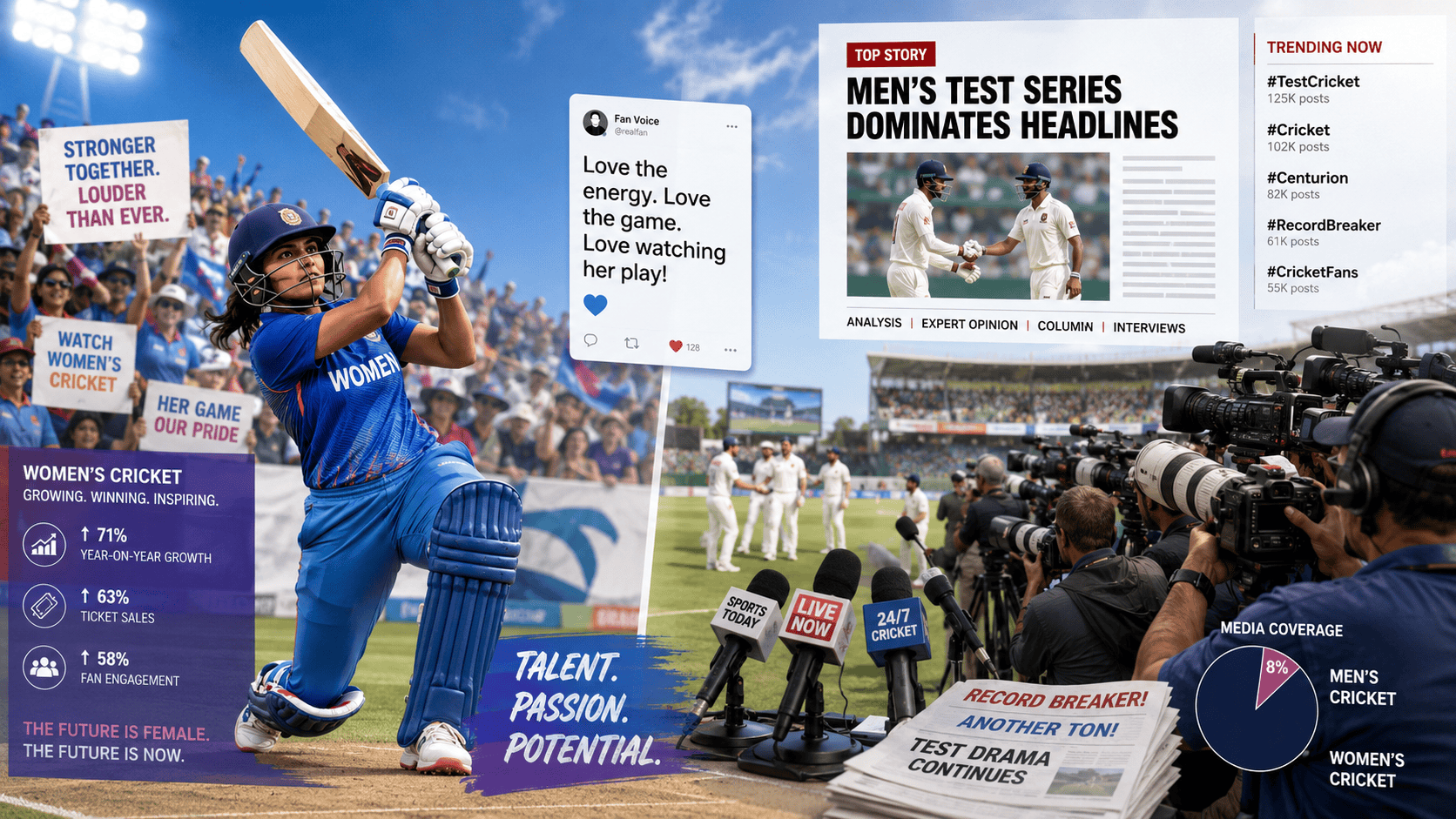
Women’s cricket has never been more popular. Crowds are growing, television audiences continue to rise, and major ICC tournaments regularly attract millions of viewers around the world. Yet whenever the women’s game clashes with a high-profile men’s series, the spotlight almost always shifts back to the men’s side. The result is a familiar story of limited women’s cricket media coverage, despite the growing popularity of the women’s game.
The issue is not a lack of interest from fans. Instead, it is a structural problem that continues to shape how cricket is reported, promoted, and consumed.
The Visibility Gap
One of the biggest reasons why women’s cricket gets less attention is overlapping schedules. Studies have shown that when women’s cricket has the calendar to itself, media coverage rises significantly. However, as soon as a major men’s series or Test match begins, coverage of women’s cricket drops sharply.
This overlap creates a visibility gap. Historic performances, record-breaking innings, and memorable victories often receive less attention because the headlines are dominated by men’s cricket.
The imbalance extends beyond news articles. Women’s sports account for only around 16 percent of mainstream sports media coverage globally, while prime-time television coverage remains below 10 percent in many markets. Fans often have to search online or use streaming platforms instead of finding matches on major television channels.
More Than Just Match Reports
Another reason behind the gender gap in cricket coverage is the difference in storytelling.
Men’s cricket is covered far beyond the final score. Fans are treated to transfer rumours, tactical analysis, dressing room stories, player interviews, feature articles, and debates that keep conversations alive between matches.
Women’s cricket often receives only match reports and score updates. Research suggests that as much as 84 percent of women’s cricket reporting focuses mainly on results rather than building narratives around players and teams.
This approach makes it harder for casual fans to develop emotional connections with emerging stars. Storytelling has always been one of sport’s biggest strengths, and women’s cricket deserves the same treatment.
A Legacy of Unequal Investment
Comparisons between women’s cricket vs men’s cricket cannot ignore history. Men’s cricket has enjoyed more than a century of professional structures, media investment, and commercial support.
Women’s cricket has had to catch up after decades of limited opportunities and underfunding. Although the quality of cricket has improved dramatically, the media ecosystem has not evolved at the same pace.
When broadcasters and publishers must choose between overlapping events, commercial priorities often favour established men’s competitions. That decision reinforces the cycle of unequal visibility.
The Audience Is Already There
The idea that women’s cricket lacks an audience is no longer supported by evidence. Digital engagement continues to grow, while major tournaments generate impressive television ratings and social media interactions.
Elite women cricketers are also becoming influential role models and attractive brand ambassadors, showing that the commercial potential of the women’s game is stronger than ever.
The challenge is no longer attracting fans. It is giving the sport equal opportunities to be seen.
Time for a Different Approach
Women’s cricket has earned its place on the global stage through outstanding performances and growing fan support. Better scheduling, greater editorial investment, and richer storytelling can help close the gender gap in cricket coverage.
Until that happens, every overlapping men’s series risks overshadowing another landmark moment for women’s cricket, preventing the sport from receiving the recognition it has already earned.
