
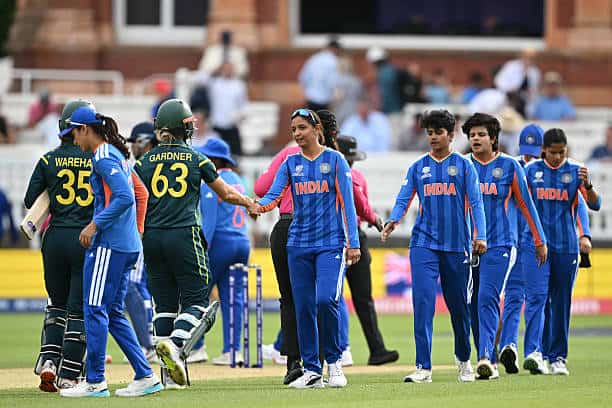
India’s campaign at the 2026 ICC Women’s T20 World Cup ended in disappointment after a group stage exit. The six-wicket defeat against Australia at Lord’s confirmed that India would miss out on the semi-finals despite entering the tournament as the reigning Women’s ODI World Champions.
The early exit has started fresh discussions about the India Women’s Cricket Strategy, team selection, and leadership. Both captain Harmanpreet Kaur and head coach Amol Muzumdar have admitted that India’s T20 approach needs a complete rethink before the next global event.
The latest India Women’s T20 team analysis shows that several areas require urgent improvement.
Batting Approach Needs a Major Change
One of the biggest concerns during the tournament was India’s batting strategy.
Modern T20 cricket rewards teams that attack throughout the innings, especially during the middle overs. Australia and South Africa consistently kept the scoreboard moving with aggressive batting, while India often slowed down after the powerplay.
India recorded a dot ball percentage of 29.8 percent, much higher than Australia’s 20.5 percent. The team’s boundary percentage of 16.2 percent was also the lowest among the top four teams.
The middle order, featuring Yastika Bhatia, Jemimah Rodrigues, and Harmanpreet Kaur, often focused on rotating the strike instead of attacking. As a result, India regularly left too much work for the final overs, making it difficult to post or chase challenging totals.
Improving the India Women’s cricket strategy will require a more fearless batting mindset.
Bowling Combinations Lacked Stability
Another issue highlighted in the India Women’s T20 team analysis is the constant changes to the pace attack.
India used five different pace bowling combinations during just five group stage matches. Young bowlers like Nandani Sharma and Kranti Gaud were rotated frequently, while experienced bowlers Renuka Singh and Arundhati Reddy played only two matches each.
The lack of consistency prevented the bowling unit from building rhythm and understanding. Frequent changes also made it difficult for players to settle into clearly defined roles.
A more stable bowling lineup could help India perform better in future tournaments.
Fielding Continues to Hurt India
Fielding remains one of India’s biggest weaknesses in major tournaments.
The team dropped 10 catches during the group stage, the third highest number in the competition. One of the most costly moments came against South Africa when Marizanne Kapp was given multiple chances before guiding her team to victory.
At the international level, such mistakes often decide important matches, making fielding another priority area for improvement.
India Women’s Captaincy Debate Grows Stronger
The disappointing campaign has also intensified the India Women’s captaincy debate.
Harmanpreet Kaur has now led India in five Women’s T20 World Cups, but the team has failed to reach the knockout stage in the last two editions. Her own batting form has also been inconsistent, with only four scores above fifty in her last 24 T20I innings.
While head coach Amol Muzumdar has publicly supported the experienced captain, many believe it may be time to look towards the future. Vice captain Smriti Mandhana remains a strong leadership option, while several young players have emerged through the Women’s Premier League.
The India Women’s cricket strategy now faces a defining moment. With another T20 World Cup cycle beginning, selectors and team management must decide whether to continue with the current leadership or start a new era. The choices made over the coming months could shape the future of India’s Women’s T20 team for years to come.
