
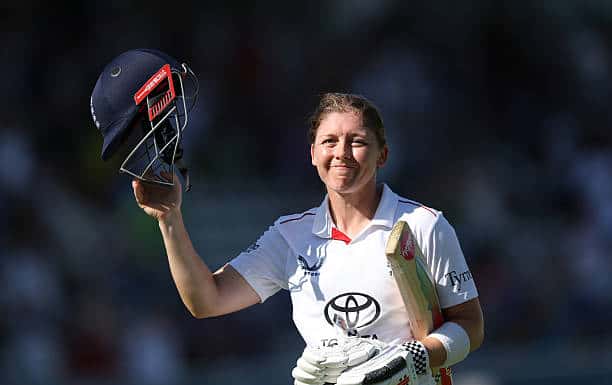
The landmark women’s Test between England and India at Lord’s became even more emotional on Saturday as Heather Knight announced that the match would be the final international appearance of her illustrious career.
While India held a commanding position in the contest, the day belonged to England’s former captain, who chose one of the most symbolic stages in women’s cricket to say goodbye.
Rather than waiting until after the final ball to reflect on her journey, Knight confirmed her decision during a historic Test at the Home of Cricket, a match that marks another important step in the evolution of the women’s game.
Knight Leaves As England’s Most-Capped Player
Knight will leave international cricket as England Women’s most-capped cricketer.
Since making her debut in 2010, she has represented her country in 320 matches across formats. During that period, she scored 7,988 international runs, including six centuries.
She also became the first England cricketer, male or female, to score international hundreds in all three formats: Tests, ODIs and T20Is.
Those numbers reflect not only her quality but also her consistency across a period in which women’s cricket changed dramatically and moved towards full professionalism.
A Captain Who Continued England’s Growth
While Charlotte Edwards laid the foundations of modern England women’s cricket, Knight helped ensure that the game continued to grow. She took over the captaincy in 2016 after Edwards’ retirement and embraced one of the most demanding roles in English cricket.
Knight went on to captain England in 199 internationals, winning 134 of them.
Her defining moment as leader came at Lord’s in 2017, when she lifted the ICC Women’s World Cup after England’s memorable victory over India.
That triumph inspired a new generation of girls to take up cricket and helped accelerate the growth of the women’s game across England.
Big-Match Player Until The End
Knight’s influence did not end when Nat Sciver-Brunt took over the captaincy. Even after stepping away from leadership, she continued to deliver important performances on the biggest stages.
Her fluent, match-winning 109 against India in the 2025 ODI World Cup in Indore was a reminder of everything that made her batting special. Named Player of the Match, Knight produced an innings built on composure, timing and control rather than raw power.
One stroke from that innings captured her style perfectly. Facing Renuka Singh Thakur early in her knock, Knight waited deep in her crease, opened the face of the bat and guided a late cut to the boundary.
It was a classic Heather Knight shot.
Her batting was always defined by grace, intelligence, timing, creativity and the ability to absorb pressure before standing up for her team when it mattered most.
A Legacy Beyond Statistics
Statistics alone cannot fully explain Knight’s influence on English cricket. Calm under pressure, composed in difficult moments and deeply respected inside the dressing room, she became one of the most dependable leaders in the women’s game.
Whether anchoring England’s batting or guiding a younger side through transition, Knight represented professionalism, resilience and quiet authority. Her career has been closely linked with the rise of women’s cricket from a developing pathway into a more professional and visible sport.
That wider impact will form an important part of how her legacy is remembered.
A Farewell At Lord’s
The timing of Knight’s farewell feels especially meaningful.
This week, Lord’s hosted its first-ever women’s Test, exactly the kind of occasion that reflects how far the women’s game has travelled during her career.
By announcing her retirement during the match, while the contest was still unfolding, Knight symbolically passed the baton to the next generation of players tasked with taking the game forward.
The final result of the Test is still to be decided, but Knight’s legacy is already secure. After Charlotte Edwards, she stands among England’s finest batters and captains.
As Lord’s celebrates a landmark chapter in women’s cricket, Knight’s farewell serves as a reminder that the sport’s progress has been shaped by players who helped leave the game stronger than they found it.
