
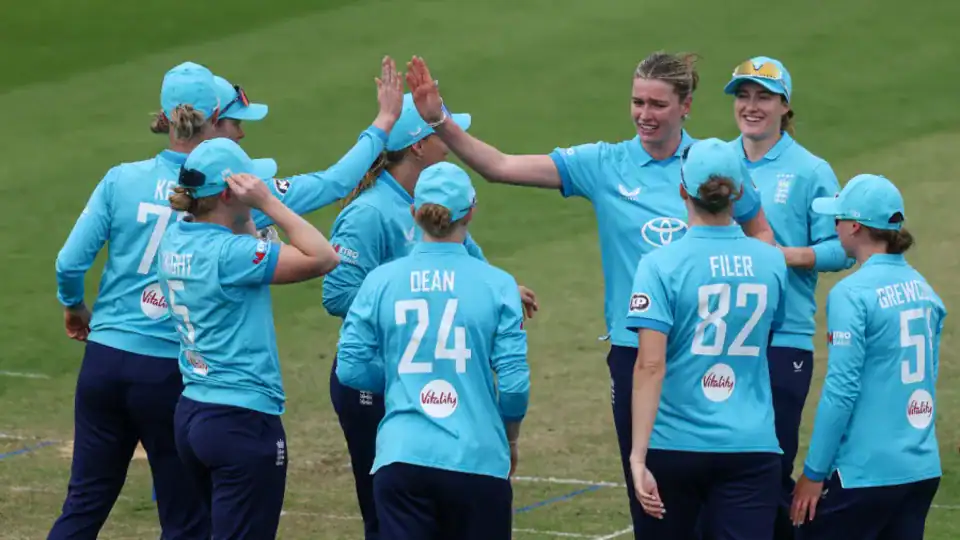
The rain-affected ODI series between England and New Zealand offered limited clarity ahead of the upcoming Women’s T20 World Cup, but it still provided both teams with key takeaways as they prepare for the next phase.
With one win apiece and a washout in the middle fixture, the series lacked rhythm, yet the conditions and performances revealed important trends for both sides ahead of the T20 leg beginning in Derby.
New Zealand Building for the Future
New Zealand appear to be transitioning towards a new phase, particularly with Suzie Bates playing her 184th and final ODI. The White Ferns are preparing for life beyond experienced players, with younger batters stepping into more prominent roles.
Maddy Green played a central role during the series, earning Player of the Series honours with scores of 88 and 37, while also building key partnerships with Brooke Halliday and Izzy Gaze. These contributions highlighted improved depth in the batting line-up.
“The team’s in a really good place and we’ve got people throughout our line-up who are willing to stick their hands up at different times,” Green said. “Teams five, 10 years ago were probably guilty of relying on a couple of our senior players, but it feels like at the moment we’ve got genuine match-winners throughout our whole side and that’s really exciting.
“A couple of years ago we came over here with a very young side and hadn’t played a lot of cricket. We’ve had that core group together now for a wee while now and I think we’re just in a good spot. Obviously we’re moving to the T20s in a different format and hopefully we can take this momentum into that series as well.”
The bowling unit also showed promise, with Rosemary Mair and Bree Illing stepping up alongside Jess Kerr, particularly during the powerplay in Cardiff.
England Continue to Experiment
England used the series to test combinations, with several key players unavailable. Changes at the top of the order saw Emma Lamb return to an opening role alongside debutant Jodi Grewcock, though the pairing remains untested.
Head coach Charlotte Edwards also introduced new players, including Tilly Corteen-Coleman and Dani Gibson, as part of a broader effort to develop depth in the squad.
“We’ve had a really good series,” Charlie Dean said. “We’ve had three debutants, so we need to really start blooding some of the next generation to play in ODI cricket and I feel like that’s something that we’ve done and there’s been lots of learnings from that. Didn’t get on the right side of it today, but I feel like in parts we were good in places and then there’s lots to learn from as well.”
Leadership and Bowling Positives
Charlie Dean’s stint as stand-in captain provided valuable experience as she managed changing match conditions and tactical decisions across the series.
Lauren Bell emerged as a key performer with the ball, producing impactful spells, including three wickets in quick succession in Cardiff. Her role becomes increasingly important with injuries affecting England’s pace options.
Batting Concerns Remain
Despite some individual contributions, England’s batting line-up showed inconsistencies. Maia Bouchier’s 59 in Durham was the highest score of the series for England, while Alice Capsey’s 45 provided stability without converting into a bigger innings.
Frequent dismissals in similar fashion highlighted areas for improvement, with both teams recognising the need for greater consistency ahead of the World Cup.
With the ODI series offering mixed outcomes, attention now shifts to the T20 matches, where both England and New Zealand will look to refine their combinations and carry forward the lessons learned.
