
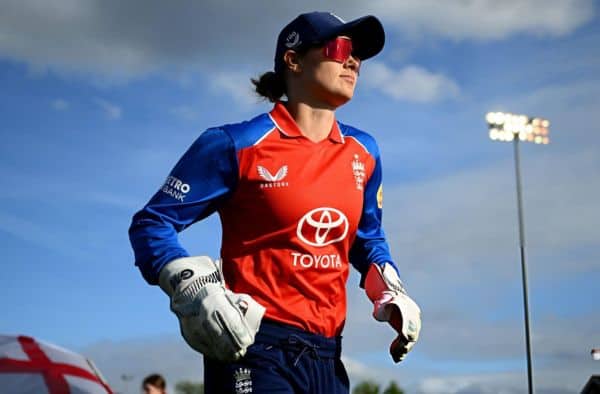
Amy Jones reached a significant milestone in her England career when she made her 250th international appearance in the third and final T20I against New Zealand at the County Ground, Hove, on 25 May 2026.
The 32-year-old wicketkeeper-batter began the three-match T20I series three appearances short of the landmark, having built a long and adaptable international career across formats since making her ODI debut in February 2013. Her durability, along with the value she provides with the gloves and bat, explains why Jones remains an important part of England’s plans as they complete preparations for the home ICC Women’s T20 World Cup in June.
Jones made her ODI debut against Sri Lanka at Brabourne on 1 February 2013. Her T20I debut followed on 5 July 2013 against Pakistan at Loughborough.
She has now played 114 ODIs, 128 T20Is, and 8 Tests, taking her overall tally to 250 international matches. Her ODI record stands at 2,689 runs from 96 innings at an average of 32.39 and a strike rate of 85.36, with 16 half-centuries and two hundreds in 114 matches.
In T20Is, Jones has scored 1,667 runs from 102 innings at an average of 20.32 and a strike rate of 121.59, including five half-centuries from 128 matches. Her best T20I innings came against Pakistan in Kuala Lumpur on 19 December 2019, when she made 89 off 52 balls with 11 fours and three sixes. She was named Player of the Match as England scored 185/5 and won by 84 runs.
Jones made her Test debut against Australia at Taunton on 18 July 2019. In the format, she has scored 188 runs from 13 innings at an average of 14.46 and a strike rate of 47.95, with one fifty in eight matches so far.
A Milestone Built On Consistency
Reaching 250 international matches reflects Jones’s sustained performance, fitness, and ability to adapt across formats and team requirements. For a wicketkeeper-batter in modern women’s cricket, where rotation, workload management, and format-specific roles have become increasingly common, the milestone marks her as a trusted and durable figure in England’s setup.
Her experience is particularly valuable during a busy white-ball period. England are preparing for a three-match T20I series against India from 28 May, followed by the ICC Women’s T20 World Cup 2026 on home soil from 12 June.
England hosted New Zealand in a white-ball series from 10 to 25 May 2026, with three ODIs followed by three T20Is. The ODI series finished 1-1: England won the first ODI by one wicket, the second match was washed out, and New Zealand won the third by 17 runs to level the series.
The T20I series began on 20 May 2026, with England winning the opener by seven wickets. New Zealand then squared the series with a 14-run victory in the second T20I. The decider at Hove on 25 May brought Jones’s 250th cap and ended with England sealing the series through a seven-wicket win. New Zealand, led by Amelia Kerr, arrived with a balanced white-ball squad looking to challenge England’s preparations during a busy month.
Jones Remains Central To England’s Plans
Jones’s wicketkeeping and reading of the game continue to be important to England’s fielding structure. Her presence gives the bowlers stability behind the stumps and allows them to execute plans with a reliable partner in place.
She has also been used flexibly throughout her career, opening in T20s and batting in the middle order in ODIs. That versatility gives England tactical options against different bowling attacks.
England’s late-May and early-June white-ball schedule is effectively their final preparation phase before the ICC Women’s T20 World Cup 2026, which will be staged in England and Wales from 12 June to 5 July. The 10th edition of the tournament has been expanded to 12 teams, and England will begin their campaign against Sri Lanka, captained by Chamari Athapaththu, in Birmingham on 12 June at 11:00 PM IST.
Before the World Cup, England will host India for three T20Is from 28 May to 2 June. That series will provide another high-quality test and help head coach and captain Nat Sciver-Brunt assess form, balance, and combinations before the tournament.
Jones’s 250th appearance arrived at a meaningful time in her career. She is now one of the senior figures in an England squad that combines emerging players with experienced internationals. Such milestones are personal achievements, but they also allow teams and supporters to recognise continuity and long-term contribution.
For Jones, the landmark adds to a career built on steady runs, consistent wicketkeeping, and a willingness to take on different roles when required. It also reflects the changing shape of women’s cricket, where more fixtures, multi-format tours, and expanded global tournaments are giving leading players the opportunity to build lasting appearance records.
