
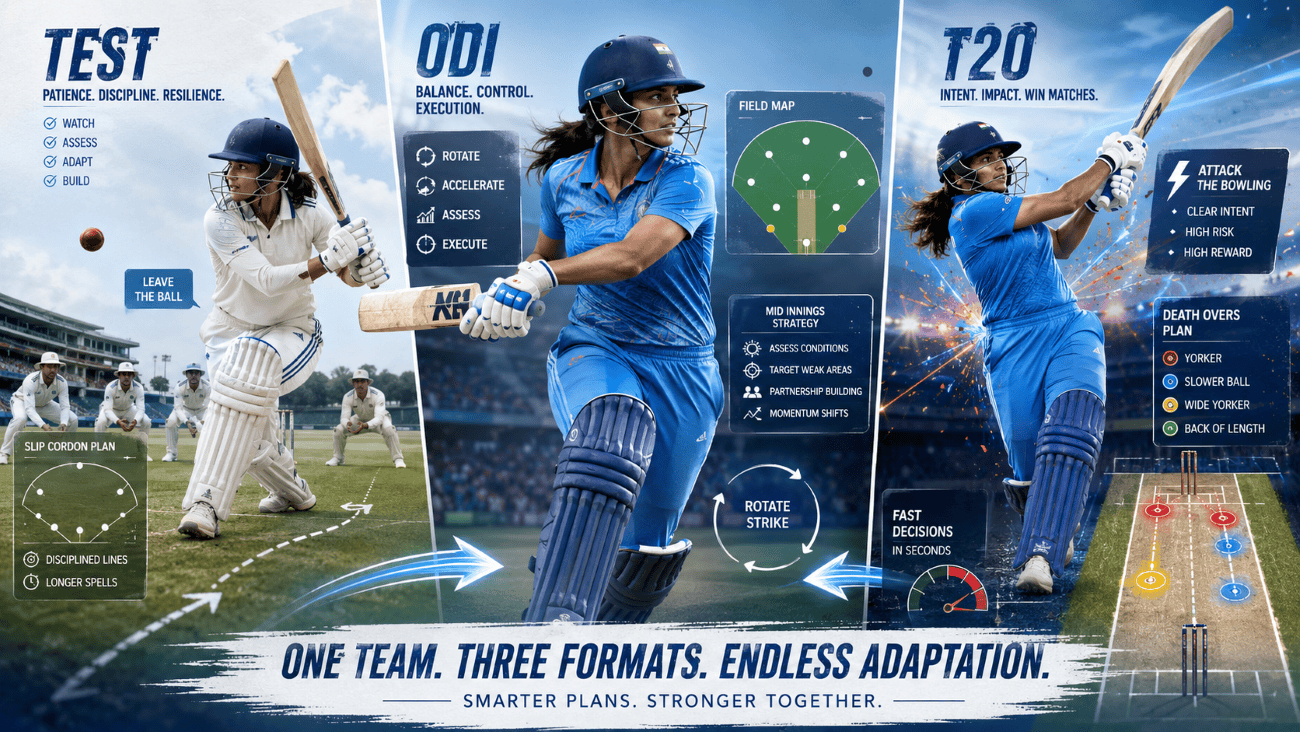
Modern women’s cricket demands much more than talent. Every international format requires a different mindset, different skills, and different tactical planning. The Indian women’s cricket team has steadily improved its ability to switch between Test matches, One-Day Internationals, and T20 Internationals by making smart adjustments based on the demands of each format. This India cricket tactical changes approach has become an important part of the team’s success as it competes against the world’s strongest sides.
Test Cricket Demands Patience and Discipline
Test cricket is the toughest format because players must perform consistently over several days. Unlike T20 cricket, where batters look to score quickly, Tests require patience and careful shot selection. This forms a key part of India’s multi-format strategy.
Opening batters like Smriti Mandhana and Yastika Bhatia focus on spending time at the crease. They leave deliveries outside the off stump and avoid unnecessary attacking shots early in the innings. Their main goal is to build long partnerships before aggressive players such as Richa Ghosh increase the scoring rate against tired bowlers later in the innings.
The bowling strategy also changes significantly. Instead of defensive field placements seen in white-ball cricket, India uses attacking fields with slips and close fielders to create wicket-taking chances. Spin bowlers Deepti Sharma and Sneh Rana play a major role by maintaining tight lines and forcing batters into mistakes through pressure built over several maiden overs.
ODIs Balance Patience with Controlled Aggression
The fifty-over format acts as the bridge between Tests and T20s. India’s ODI plans combine careful innings building with timely acceleration, making it an important example of India cricket tactical changes.
During the opening ten overs, the top order focuses on building a solid platform while protecting wickets. Between overs eleven and forty, batters rotate strike regularly and avoid long periods without scoring. Harmanpreet Kaur and Jemimah Rodrigues take responsibility for maintaining the scoring rate while also stabilizing the innings whenever early wickets fall.
In the final ten overs, power hitters like Richa Ghosh are expected to attack freely. This structured batting order allows India to finish strongly without taking unnecessary risks early in the innings.
The bowling attack follows a similar balance. Renuka Singh looks for swing with the new ball to claim early wickets, while India’s spin all-rounders control the middle overs by keeping scoring opportunities limited.
T20 Cricket Requires Immediate Intent
T20 cricket is the fastest format and demands aggressive decision-making from the very beginning. India’s multi-format strategy shifts towards attacking cricket with greater flexibility.
Openers Shafali Verma and Smriti Mandhana aim to make full use of the Powerplay by playing positive shots over the infield. Rather than simply rotating strike, they focus on scoring boundaries to build momentum.
India also changes its batting order depending on match situations. Left hand and right hand combinations are used to disrupt bowlers, while powerful hitters can be promoted if quick runs are required.
At the bowling end, tactics become more defensive during the closing overs. Wide yorkers, slower deliveries, and accurate stump to stump bowling help reduce boundary opportunities during the death overs.
Managing Cross Format Challenges
Switching between formats remains one of the biggest challenges in women’s cricket. Players must quickly change their mindset, technique, and shot selection. A batter coming directly from T20 cricket must avoid risky strokes in Tests, while someone returning from Test cricket needs to score much faster in T20 matches.
Workload management is equally important. Senior players like Harmanpreet Kaur, Smriti Mandhana, and Deepti Sharma regularly feature across all formats, making fitness and recovery essential. Bowlers also need to adapt from four-over T20 spells to much longer workloads in Test cricket while maintaining high fielding standards.
Conclusion
The ongoing India team tactical analysis shows that India’s women’s team has developed a flexible approach for every format. By adjusting batting tempo, bowling plans, field placements, and player roles, the team continues to strengthen its overall performance. As women’s cricket grows globally, these tactical adjustments and a well-planned India’s multi-format strategy will remain vital for India’s success across all international competitions.
