
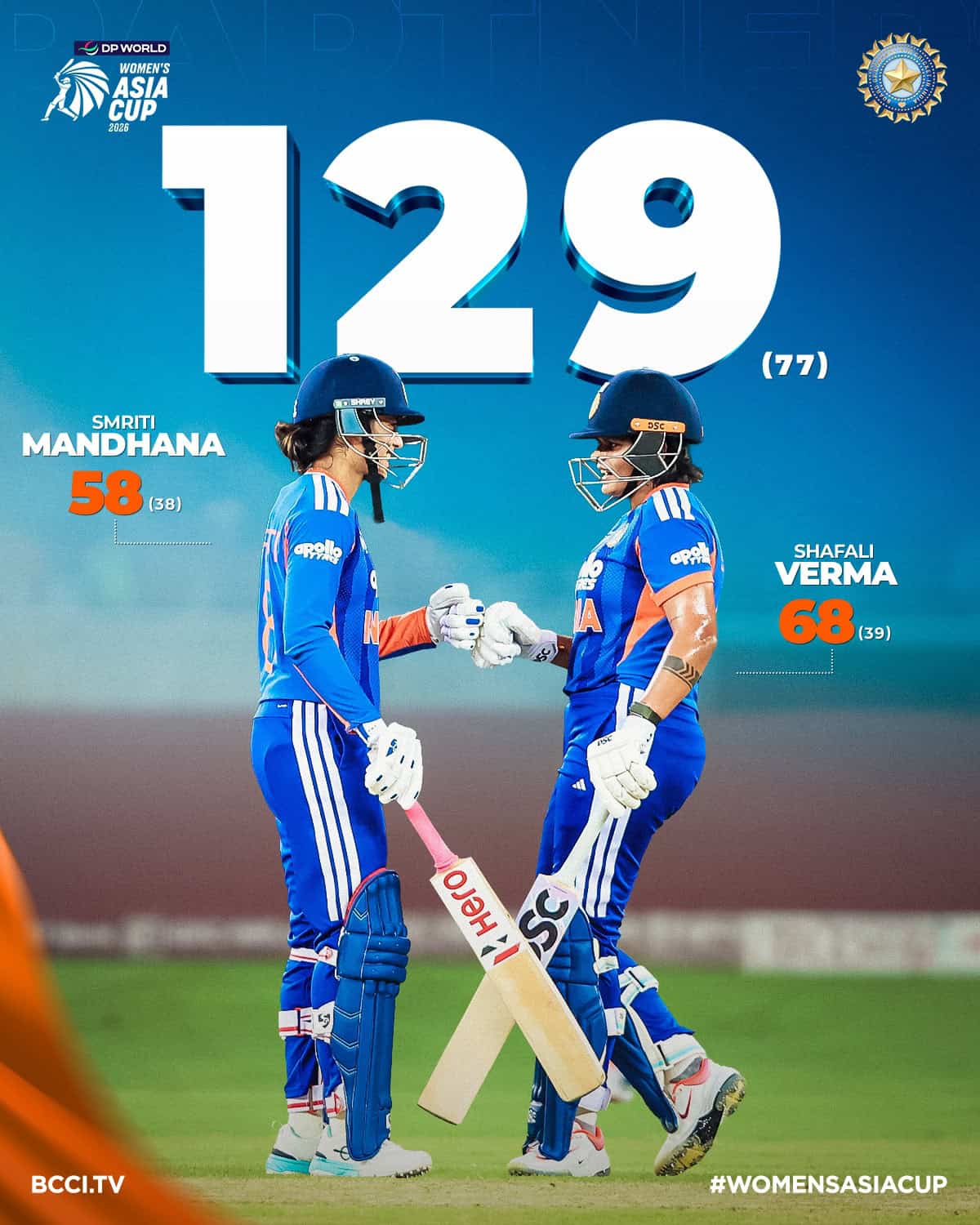
India secured eighth Women’s Asia Cup title after defeating Sri Lanka by 72 runs in the final in Dubai. While the result highlighted India’s dominance in the tournament, the campaign also exposed an important difference between the team’s opening pair and its middle order. Shafali Verma’s Women’s Asia Cup 2026 campaign was particularly impressive, but India’s batting unit behind Shafali Verma and Smriti Mandhana struggled to maintain the same level of momentum.
Shafali Verma Leads India’s Batting
Shafali finished the tournament as India’s leading run-scorer and the overall top run-getter with 236 runs from five innings. Her performances at the top of the order gave India fast starts throughout the tournament and helped the team build strong platforms in important matches.
The final against Sri Lanka was another example of her impact. Shafali smashed 68 from just 39 balls and reached her half-century in only 24 deliveries, setting a new record for the fastest fifty in Women’s Asia Cup history. She also shared a record 129-run opening partnership with Mandhana, the highest opening stand for any wicket in the history of the competition.
Her consistency was equally impressive. Shafali recorded three fifty-plus scores during the tournament, scoring 64 from 36 balls against Thailand, 64 from 40 balls against Bangladesh in the semi-final and 68 from 39 balls in the final. Shafali Verma’s Asia Cup runs were crucial to India’s successful title campaign.
Middle Order Fails to Match the Openers
The contrast became clear when looking at India’s overall batting numbers. Mandhana finished with 213 runs, but captain Harmanpreet Kaur was India’s next highest scorer with only 71 runs, while Pratika Rawal contributed 56.
India’s middle order also struggled to maintain the momentum created by the openers. In the final, India reached 140/2 after 15 overs but scored only 43 runs during the last five overs. Gunalan Kamalini’s late five ball cameo of 15 runs helped India reach 183, but the middle overs had provided an opportunity for a significantly bigger total.
Spin Exposes India’s Batting Problems
India’s batting problems became particularly visible on slower and turning pitches. Several middle order batters found it difficult to rotate the strike consistently against quality spin, resulting in periods where India’s scoring rate dropped considerably.
The semi-final against Bangladesh was another example. Harmanpreet struggled to 24 from 28 balls, while Richa Ghosh scored 21 from 16 deliveries. Shafali’s contribution became even more important in that match because Mandhana was dismissed for only two runs, leaving the opener to anchor the innings on a difficult two-paced surface.
Batting Combination Needs More Stability
Another concern was the constant experimentation with batting positions. Gunalan Kamalini, who had initially been considered for a higher position, was pushed down to No. 7 in the final, highlighting the uncertainty around India’s preferred middle order combination.
Head coach Amol Muzumdar played down concerns after the final, pointing towards the difficult conditions and rejecting the idea of a structural middle order collapse. However, India’s reliance on Shafali and Mandhana remains an important area for the team to address.
With major ICC tournaments ahead, India’s middle order will need to improve its ability to rotate the strike and attack spin. Shafali Verma’s Women’s Asia Cup 2026 outstanding campaign provided India with a major strength, but greater contributions from the batters following the openers could make the team more balanced in the future.
