
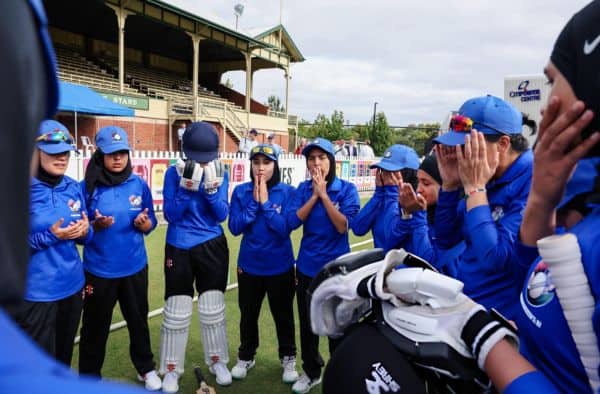
Afghanistan’s exiled women cricketers have intensified their appeal to the International Cricket Council (ICC), urging it to follow the precedent set by FIFA by recognising them as an official national team despite restrictions imposed in their home country.
Call for Action Ahead of Women’s T20 World Cup 2026
With the ICC Women’s T20 World Cup 2026 scheduled to take place in England and Wales from June 12 to July 5, the players see a crucial opportunity for the ICC to act. The tournament’s expansion to 12 teams is viewed as a chance not only to grow participation but also to address broader issues of inclusion in the sport.
Currently based in Australia, the displaced cricketers have continued training with support from advocates, including sports integrity expert Catherine Ordway of the University of New South Wales.
Comparisons With FIFA’s Decision
The renewed push follows FIFA’s recent move to adjust its regulations, allowing Afghan women footballers to compete internationally without approval from authorities in Afghanistan. Ordway highlighted this as a clear benchmark for other governing bodies.
“Well, it’s absolutely not a good look,” Ordway said. “There’s an example already out there with the International Federation for Football, and I hope that a number of other international federations will follow suit, including the cricketers.”
ICC Task Force Under Scrutiny
The ICC had previously formed a task force involving representatives from the Board of Control for Cricket in India (BCCI), England and Wales Cricket Board (ECB), and Cricket Australia to support Afghan women cricketers. However, the initiative has faced criticism over a perceived lack of progress.
“The ICC has put together a task force, which they previously put together a task force previously, which didn’t meet at all,” Ordway noted. “At least this task force has met once, but they do not have a plan as far as we can see.”
Concerns have also been raised over the absence of exiled Afghan women in the decision-making process and uncertainty surrounding funding, which is expected to expire in August.
More Than Just Cricket
Beyond recognition, the players are seeking to represent a larger cause. Their campaign aims to send a message of empowerment to women and girls in Afghanistan who face severe restrictions on education, employment, movement, and sport.
“They want to send a strong message to the women and girls stuck inside Afghanistan who are not allowed to get educated, can’t work, can’t move freely, much less play cricket,” Ordway said. “They want to send a strong message that women can do anything, but the ICC just hasn’t stepped up to the plate yet.”
Hope Around Upcoming ICC Meeting
There is cautious optimism surrounding a planned visit by the players to the UK, which coincides with an ICC meeting in Edinburgh. While the issue is not currently on the official agenda, their presence could increase pressure on the governing body to act.
Small steps, such as training camps, exhibition matches, and attendance at international fixtures,have provided some momentum, but the players are still awaiting formal recognition.
A Defining Moment for the ICC
As the global game prepares for a landmark World Cup, the ICC faces mounting pressure to address the situation. Recognising Afghanistan’s exiled women cricketers as a national team would not only align cricket with FIFA’s stance but also reinforce the sport’s commitment to inclusion and equality.
For now, the decision rests with the ICC, and the outcome could shape not just the future of these players, but the direction of women’s cricket globally.
