
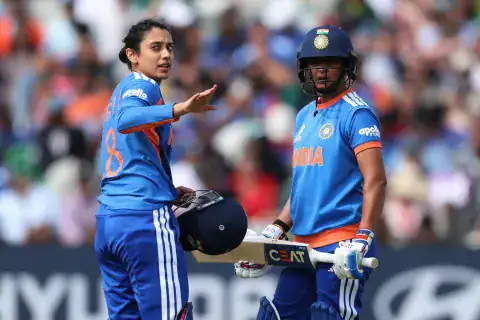
The much-anticipated India vs Pakistan Women clash at the 2026 ICC Women’s T20 World Cup lived up to expectations. Played at Edgbaston in Birmingham, the match attracted a record group stage crowd and delivered a commanding performance from India.
India began their campaign with a convincing 64-run victory over Pakistan, sending a strong message to the rest of the tournament. The match featured brilliant batting, disciplined bowling, and several important lessons that could shape both teams’ journeys in the competition.
India Recover Strongly After Early Trouble
India’s innings did not begin smoothly. The team found itself under pressure after losing two early wickets and slipping to 18 for 2.
However, Smriti Mandhana and captain Harmanpreet Kaur responded with maturity and confidence. The pair built a crucial 91-run partnership that stabilized the innings and shifted momentum back in India’s favor.
Mandhana played a superb knock of 68 runs from 44 balls, timing the ball beautifully and keeping the scoreboard moving. Harmanpreet provided valuable support with 36 runs while ensuring India remained in control.
The final push came from Richa Ghosh, who produced a quickfire 34 from only 17 deliveries. Her aggressive batting helped India reach an impressive total of 170 for 6, their highest score against Pakistan in Women’s T20 World Cup history.
This batting display forms a major part of any India vs Pakistan women analysis because it highlighted India’s ability to recover from difficult situations.
Pakistan Struggle Under Pressure
Chasing 171 was always going to be a challenging task, and Pakistan needed a strong start to stay in the contest.
Muneeba Ali fought hard with 41 runs, while Aliya Riaz added 18. However, Pakistan never built the partnerships required to threaten India’s total.
The pressure created by the required scoring rate forced Pakistan into mistakes, and wickets continued to fall at regular intervals.
This became one of the key talking points in the latest India Pakistan World Cup review, as Pakistan struggled to keep pace with the game.
India’s Spin Attack Takes Control
The turning point came when India’s spinners entered the attack.
Deepti Sharma delivered one of the finest performances of the tournament, claiming outstanding figures of 5 wickets for just 10 runs. She also contributed with a crucial direct hit run-out that further damaged Pakistan’s hopes.
Young spinner Shree Charani provided excellent support by taking 3 wickets for 21 runs.
Together, the pair completely controlled the middle overs and prevented Pakistan from building momentum.
The effectiveness of India’s spin attack offers one of the biggest tactical lessons from India vs Pakistan. On slower surfaces, disciplined spin bowling can quickly change the direction of a match.
What This Result Means
For India, this victory provides confidence and valuable momentum at the start of the tournament. The batting lineup showed resilience, while the bowling attack displayed depth and control.
For Pakistan, the defeat highlights areas that need improvement. The team must find ways to handle spin better and build stronger partnerships during pressure situations.
These factors will remain central to future India vs Pakistan women analysis discussions.
Final Verdict
The latest India – Pakistan World Cup review shows why India remains one of the strongest teams in women’s cricket. After recovering from an early setback, they dominated every department of the game.
Most importantly, the match delivered valuable tactical lessons from India vs Pakistan, particularly regarding the importance of partnerships, finishing power, and quality spin bowling. If India continue performing at this level, they will be serious contenders for the 2026 Women’s T20 World Cup title.
