
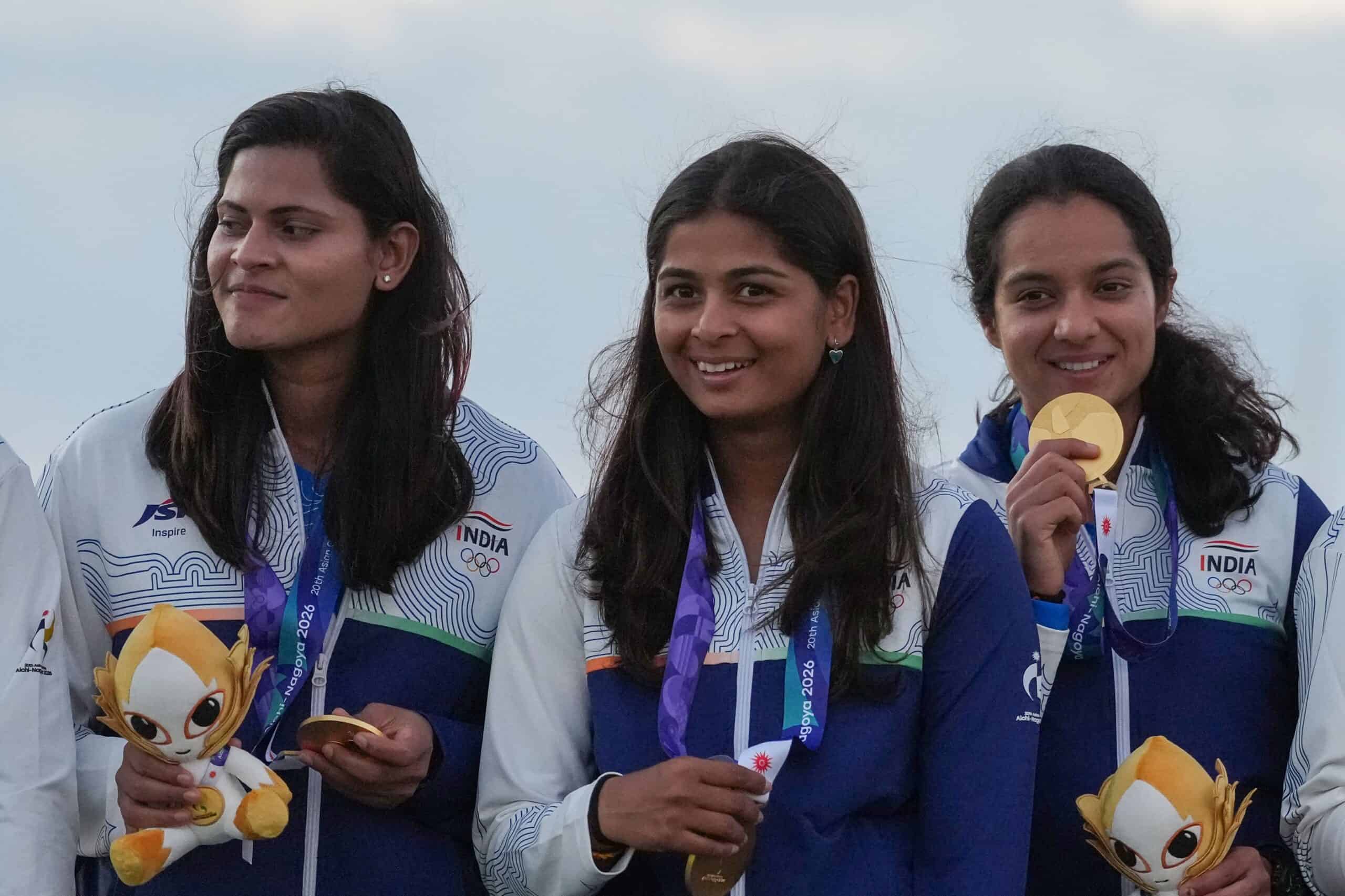
India’s latest Asian Games gold medal triumph features more than just one storyline. The first is of sustained excellence, with India proving why they remain the benchmark in Asian women’s cricket. The second looks further ahead, projecting how this dominance can be preserved once the current generation eventually steps aside.
Only ten days after defeating Sri Lanka in the Women’s Asia Cup final, India overcame the same opponents again to claim Asian Games gold in Japan. Winning the continent’s two biggest tournaments in quick succession underlines the dominance India currently enjoy over their regional rivals.
Yet success today should not delay planning for tomorrow.
With women’s cricket set to return to the Olympic Games at Los Angeles 2028, India finds itself in an enviable position. There is no immediate need for a rebuild. Instead, the challenge is to gradually introduce the next generation while the established stars continue to lead the side.
Building Around an Established Core
India’s batting remains anchored by one of the strongest top orders in the women’s game.
Smriti Mandhana continues to provide stability and experience at the top, while Shafali Verma has evolved into one of the most destructive opening batters in T20 cricket. Behind them, Richa Ghosh has developed into a dependable finisher while also giving the team continuity behind the stumps.
Their consistency, however, naturally limits opportunities for emerging players. That makes succession planning less about replacing established names immediately and more about preparing players for clearly defined future roles.
Fulmali Can Add Balance
Bharti Fulmali remains an intriguing option for India’s long-term plans.
As another left-handed batter, she offers valuable variety in a batting line-up currently led by Mandhana as its only established left-hander. Her ability to handle spin effectively makes her particularly suited to conditions across Asia.
Although Fulmali has yet to consistently convert starts into substantial innings, her technical qualities remain evident. Giving her sustained opportunities rather than judging her on isolated performances could allow her to develop into a reliable top or middle-order option over the coming years.
Kamalini’s Versatility Strengthens India’s Options
Kamalini represents another player with significant long-term value.
Her batting technique suggests she could eventually develop into a dependable No. 3, a position that will become increasingly important as India’s current senior batters progress through the latter stages of their careers.
Equally important is her wicketkeeping ability. Like Richa Ghosh, Kamalini has the potential to develop into a genuine wicketkeeper-batter, giving India greater flexibility when selecting future squads.
A Promising Bowling Pipeline
India’s long-term planning also extends to the bowling department.
Shreyanka Patil has shown the attributes required to become an important middle-overs spinner capable of controlling scoring rates while exploiting favourable match-ups.
Sree Charani has already demonstrated her ability to produce breakthroughs, highlighted by her four-wicket haul against Japan during the Asian Games. Nandani Sharma has emerged as another promising pace option, while Kranti Gaud continues to strengthen the depth of India’s developing bowling resources.
Each brings a different skill set, allowing India to build a broader pool of international-ready bowlers rather than relying on a handful of established names.
Preparing for the Next Cycle
India’s recent success means there is no urgency to make significant changes. Instead, the priority should be careful integration. Introducing young players alongside experienced campaigners allows them to learn in a winning environment without carrying the pressure of immediate expectations.
That approach becomes even more important with the Olympic Games now on the horizon. By the time Los Angeles 2028 arrives, India will want both proven match-winners and a new generation already comfortable performing on the biggest stage.
Winning gold in Japan confirmed India’s current superiority in Asian women’s cricket.
Ensuring that success continues well beyond this generation may prove an even greater achievement.
