
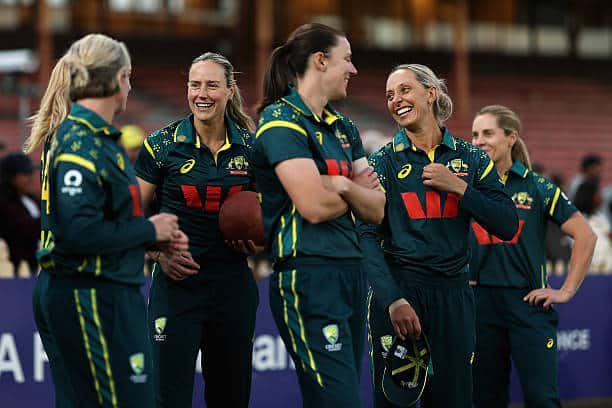
Australia survived a dramatic batting collapse to secure a two-wicket victory over New Zealand in the opening women’s T20I at North Sydney Oval on October 18, 2026. Ellyse Perry’s aggressive half-century proved decisive as the hosts chased down a target of 163 with seven balls remaining.
Playing their first T20I since winning the World Cup, Australia struggled to maintain control of the chase despite appearing comfortably placed during the middle overs. Perry struck 52 from 30 deliveries, but a series of careless dismissals left the hosts struggling at 145 for 7 in the 16th over.
Captain Sophie Molineux guided Australia closer to victory before Rosemary Mair bowled her as she attempted a lap sweep, leaving four runs required. Kim Garth then produced a well-timed square drive to the boundary to complete a narrow win.
Match Summary
- New Zealand: 162/2 (20 overs) — Georgia Plimmer 85*, Maddy Green 56*; Annabel Sutherland 1/28, Kim Garth 1/34.
- Australia: 165/8 — Ellyse Perry 52, Beth Mooney 38; Jess Kerr 3/25.
- Result: Australia won by two wickets with seven balls remaining.
- Series: Australia lead the three-match T20I series 1-0.
Australia entered the contest without Phoebe Litchfield, who was unavailable because of a hip injury. Tahlia McGrath replaced her in the only change from the team that defeated England in the T20 World Cup final in July.
For New Zealand, the match marked the beginning of a new phase following the retirements of experienced players Sophie Devine, Suzie Bates and Lea Tahuhu.
Perry Leads Australia Despite Unconvincing Batting Display
Australia’s chase began poorly when Georgia Voll was dismissed on the second delivery of the innings. Left-arm seamer Bree Illing trapped Voll lbw with an inswinging delivery. The batter challenged the decision, but the review returned an umpire’s call, leaving Australia with an early setback.
Perry and Beth Mooney quickly restored control through an attacking 86-run partnership. The pair combined regular boundaries with aggressive running between the wickets to put New Zealand’s bowlers under pressure.
Mooney was particularly eager to contribute after a difficult performance behind the stumps earlier in the match.
She also experienced problems with her contact lenses and removed them during the early stages of her innings. However, the issue appeared to have little influence on her batting as she continued to score freely alongside Perry.
Mooney looked capable of reaching a half-century before a moment of confusion ended her innings on 38.
Following a loud lbw appeal, she attempted a run that was not available and was run out in unusual circumstances.
Perry continued attacking despite losing her partner. She brought up her half-century from 27 balls with an impressive straight drive, maintaining Australia’s advantage in the chase.
Her innings ended shortly afterwards when she struck a short delivery from Jess Kerr directly to deep backward square leg.
Ashleigh Gardner contributed a brief attacking innings to move Australia closer to their target, but Jess Kerr dismissed her lbw following a review.
Australia then lost further wickets, including Nicola Carey, who was run out after a misunderstanding between the batters.
The repeated setbacks threatened to undo the work of Perry and Mooney before Garth eventually struck the winning boundary.
New Zealand’s Young Bowling Attack Pushes Australia
New Zealand appeared to be heading towards a comfortable defeat when Perry and Mooney were scoring freely. However, the visitors continued taking wickets and gradually brought themselves back into contention.
Although they could not complete the upset, captain Melie Kerr had reasons to be encouraged by the performance of her inexperienced side.
Illing, playing her 16th T20I, made an immediate impact with the new ball and troubled Australia’s top order.
Jess Kerr was equally important during the later stages, claiming three wickets for 25 runs from her four overs.
Her dismissals helped New Zealand maintain pressure as Australia’s middle and lower order struggled to finish the chase.
Melie Kerr, however, endured a difficult outing with the ball. She conceded 50 runs from four overs, recording the most expensive bowling figures of her career.
Despite that setback, New Zealand’s ability to remain competitive against the World Cup champions offered encouragement for the developing team.
Lucy Hamilton Struggles on Return to Australia’s Side
Australia faced a selection decision before the match after left-arm fast bowler Lucy Hamilton recovered from a hip injury.
The injury had ruled Hamilton out of the ODI series against Bangladesh, during which experienced seamer Megan Schutt impressed by taking 10 wickets across three matches.
Selectors ultimately chose to bring Hamilton back into the playing XI.
However, the young quick struggled to make an impact with the ball, conceding 23 runs from two overs without taking a wicket.
Introduced during the fourth over, Hamilton found it difficult to maintain a consistent length against New Zealand’s batters.
She did, however, produce Australia’s outstanding fielding moment.
Positioned at fine leg, Hamilton dived forward to complete an excellent catch that dismissed Melie Kerr.
Elsewhere, Australia’s fielding performance was below its usual standard.
Mooney had an unusually difficult match as wicketkeeper, missing a stumping opportunity and dropping a catch while standing up to the stumps.
Those mistakes allowed Georgia Plimmer to continue her innings after being given chances on 15 and 39.
Georgia Plimmer and Maddy Green Rebuild New Zealand’s Innings
New Zealand entered the match with questions surrounding their batting lineup following the departures of Devine and Bates after the T20 World Cup.
The visitors introduced a new opening partnership featuring Plimmer and Flora Devonshire, both in their early twenties.
Devonshire’s promotion represented a significant change in her batting role. The spin-bowling all-rounder had been listed at No. 9 in her previous three T20I appearances without getting an opportunity to bat.
Her first outing as an opener lasted only four deliveries.
Garth produced a sharply swinging delivery that passed through Devonshire’s defence and bowled her.
Plimmer, meanwhile, approached her innings with determination after previously losing her place during New Zealand’s disappointing T20 World Cup campaign.
Having played 55 T20Is, she was considerably more experienced than her new opening partner and took responsibility for providing stability at the top of the order.
After a relatively cautious beginning, Plimmer increased her scoring rate and reached her half-century from 40 deliveries.
She continued batting positively, eventually finishing unbeaten on a career-best 85 from 68 balls.
Maddy Green provided crucial support and helped New Zealand recover from their early setbacks.
As the most experienced member of the side, Green played a controlled innings before accelerating during the closing overs.
She struck 14 runs from three consecutive deliveries against Carey and completed her half-century from 33 balls.
Green finished unbeaten on 56 from 37 deliveries, sharing an unbroken 129-run partnership with Plimmer.
Their efforts lifted New Zealand to 162 for 2 after 20 overs, although the visitors were left wondering whether greater aggression earlier in the innings might have produced a more challenging total.
Australia eventually reached 165 for 8 to claim the opening match, but the narrow margin highlighted New Zealand’s competitiveness.
Perry’s half-century provided the foundation for Australia’s victory, while Plimmer and Green demonstrated that New Zealand’s inexperienced batting group could challenge the reigning world champions.
The result gives Australia a 1-0 advantage in the three-match series, although their batting collapse and missed fielding opportunities leave areas to address before the next encounter.
