
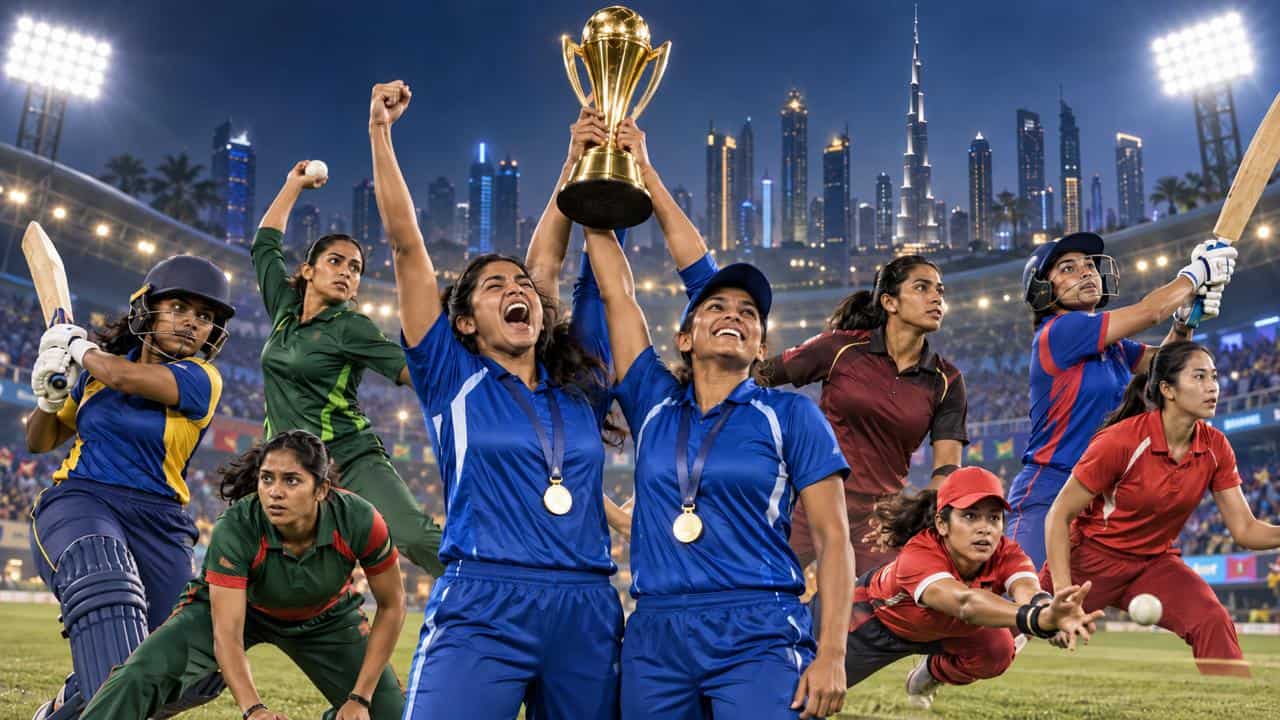
The Women’s T20 Asia Cup 2026 was more than another regional tournament. Held at the Dubai International Cricket Stadium from August 28 to September 13, the competition offered a clear view of how women’s cricket in Asia is changing at different speeds. India eventually defeated Sri Lanka by 72 runs in the final to win their eighth Asia Cup title, but the bigger story was the growing gap between the strongest teams and the rest of the field. The tournament showed that the old idea of a closely matched Asian group led by India, Pakistan and Sri Lanka is becoming less accurate as professional training, franchise cricket and modern batting methods reshape the game.
The competition featured eight teams divided into two groups, with India, Pakistan, Thailand and Hong Kong China in Group A, while Sri Lanka, Bangladesh, UAE and debutants Indonesia formed Group B. All 15 matches were played under lights in Dubai, giving every team the same basic playing conditions while exposing the differences in preparation, experience and squad depth. India produced some of the strongest performances of the tournament, including 193/5 against Hong Kong, China and 183/5 in the final against Sri Lanka. The scale of India’s performances made it clear that Asian women’s cricket now has a team operating at a level that is increasingly difficult for others to match.
As 1xBet analyst Karan Sharma noted while looking at the wider tournament picture, the 2026 Asia Cup was not simply about one team’s dominance. It was also about the different paths teams are taking to become competitive. The tournament showed how India has benefited from a strong professional structure, while other teams are still trying to build reliable systems around a small group of leading players.
The Modern Big Three Is No Longer a Simple Three-Team Race
For many years, India, Pakistan and Sri Lanka were viewed as the central powers of women’s cricket in Asia. Bangladesh later disrupted that order, particularly with their rise in regional cricket and their ability to challenge established teams. Sri Lanka’s 2024 title also showed that India’s dominance could be challenged on the right day. However, the 2026 tournament presented a different picture because India did not just win the title. They did so with a level of batting aggression, bowling variety and squad depth that placed them apart from the rest.
India’s campaign was built around a modern approach to T20 cricket. Their batters looked to score quickly during the early overs rather than spending a long period simply protecting wickets. The final was the clearest example, with Shafali Verma producing a record-breaking 24-ball fifty and joining Smriti Mandhana in a 129-run opening partnership. Their approach created pressure before Sri Lanka could settle into the contest, showing how quickly an innings can move away from the older Asian model of building towards totals around 125 or 130.
Sri Lanka remained one of the strongest challengers because of their experience and the presence of Chamari Athapaththu. They also had enough bowling quality to challenge India at key moments. However, their batting depended heavily on a small group of players, and Athapaththu’s dismissal put greater pressure on the middle order. The final again highlighted the difference between having a few world-class players and having several layers of international quality throughout the squad.
Pakistan faced a similar problem in their semi-final against Sri Lanka. They scored 130/5, but Sri Lanka chased the target by reaching 134/6. Pakistan’s disciplined approach with the ball kept the match close, yet their batting did not produce the late acceleration needed to create a stronger total. Their campaign therefore reflected a wider problem among the second group of Asian teams. They can control matches for long periods, but they often struggle to turn control into a winning advantage against the strongest sides.
Bangladesh presented another version of the same issue. Their bowling attack, led by players such as Nahida Akter and Rabeya Khan, was capable of putting major pressure on weaker teams. Bangladesh bowled UAE out for 69 and Indonesia for 58, showing the strength of their spin attack. However, their batting continued to struggle when faced with higher targets and stronger bowling attacks, especially when they needed to score more than 140.
This creates a clear divide between India’s full squad depth and the star dependence seen elsewhere. 1xBet analyst Karan Sharma’s analysis of the tournament also points towards this difference, because the best teams are no longer defined only by their biggest names. They are increasingly defined by the quality of the players who come in when those names fail.
The Death of the Old T20 Batting Approach
The biggest tactical change visible during the 2026 Asia Cup was the decline of the old approach of simply surviving the first six overs. Asian teams traditionally placed a high value on preserving wickets early and then trying to increase the scoring rate later. That method could produce competitive totals, but it often left teams with too much work to do during the final stages of an innings.
India’s approach was very different. Their top order attacked early, and this allowed the middle order to enter with more freedom. Shafali Verma’s performance in the final represented this change perfectly. Her 24-ball fifty was not simply a fast individual innings. It showed the value of putting pressure on bowlers before they can settle into their preferred lines and lengths.
The Women’s Premier League has played an important role in this change. Indian players now have regular exposure to high-pressure T20 matches against leading international players. They also experience different game situations throughout a season rather than waiting for short international series. This has helped create a larger group of players who understand the demands of modern T20 cricket.
The impact goes beyond batting. India’s players have also become more comfortable changing their approach according to the situation. They can attack during the Powerplay, build an innings in the middle overs and then accelerate again at the end. Other teams can match India in one or two phases, but maintaining that level throughout an entire match remains difficult.
Spin bowling has also changed in purpose. It is no longer used only to slow down scoring. India showed how spin can be used to take wickets and attack batters. Sree Charani’s 4 for 20 in the final was a major example of this approach. India also bowled Pakistan out for just 55 during the tournament, showing how spin pressure can completely change the direction of a T20 innings.
Bangladesh and Thailand often used spin in a more defensive way. Their main goal was to reduce scoring options and force batters into mistakes. That approach can work against teams with limited power, but it becomes harder to sustain when facing batters capable of hitting boundaries against defensive fields.
1xBet analyst Karan Sharma analysed that the tactical difference is therefore not simply about having better bowlers. It is about how teams use their bowlers. India increasingly treats every phase as an opportunity to take control, while several other teams still focus more heavily on limiting damage.
The Rise of Thailand and the Associate Challenge
The performance of Thailand was one of the more important stories away from the leading teams. Thailand did not have the same batting power or professional structure as India, but they showed that good planning can help an Associate side remain competitive. Their approach relied on careful running between the wickets, athletic fielding, and bowling that focused on simple lines.
Naruemol Chaiwai has been an important part of Thailand’s approach because of her ability to give the team stability. Thailand often avoided unnecessary risks and looked for ways to collect runs without depending entirely on boundaries. This helped them compete with other Associate teams and showed that tactical discipline can reduce some of the gap created by limited resources.
Their bowling approach was also practical. Against aggressive batters, Thailand often used defensive lines and tried to force mistakes rather than chase wickets with constant attacking deliveries. This is a useful model for developing teams because it gives bowlers a clear plan, even when they lack the pace or variety of the leading sides.
UAE offered a different approach. Their batting was more aggressive, with players such as Esha Oza willing to take risks and attack from the start. That aggression helped UAE score quickly, but it also exposed the team to early collapses when high-quality swing bowling created pressure, as 1xBet analyst Karan Sharma explained.
This contrast shows that Associate teams are not lacking ideas. Their biggest problem is consistency and access to the same level of resources. Many players from these teams still have to balance cricket with full-time employment or education. Their international preparation periods are often much shorter than those available to players from fully professional systems.
Indonesia’s debut also carried importance despite their difficult results. Their presence showed the expanding reach of women’s cricket in Asia. However, participation alone cannot close the competitive gap. Players need regular domestic matches, specialist coaching, strength training, and frequent international exposure if they are expected to compete with teams in professional environments.
The Real Depth Gap Between Asian Teams
The biggest lesson from the tournament was not that India has better individual players. It was that India has a much deeper system behind those players. A strong international team can survive an injury, poor form or an early dismissal when several other players are prepared to perform the same role. This is where the Women’s Premier League has given India a major advantage.
The league gives Indian players access to professional facilities, experienced coaches, international teammates and high-pressure matches. It also creates opportunities for players who may not yet be regular international starters. As a result, India can develop second- and third-choice options who already understand the demands of modern T20 cricket.
The rest of Asia does not have the same depth. Sri Lanka has Athapaththu, Pakistan has players such as Fatima Sana, and Bangladesh has experienced players including Nigar Sultana and its leading spinners. However, the gap between the leading players and the next group can become very visible when matches enter difficult situations.
The final against Sri Lanka showed this clearly. Athapaththu remains capable of changing a match quickly, but when she was dismissed, Sri Lanka struggled to maintain the same scoring speed. India could apply pressure because they knew that Sri Lanka’s batting depth was not as strong as their own.
The difference becomes even more important during the final overs. Strong teams can bring in batters comfortable hitting boundaries and bowlers with several ways to stop them. Developing teams often lose control during this period because they do not yet have enough high-quality options.
This is why the gap between the 14th and 20th overs matters so much. Associate and second-tier teams can stay close for most of an innings before conceding a large number of runs at the end. They often lack the pace, bowling variations and boundary fielding needed to handle powerful finishers. Improving this phase should be one of the biggest development priorities for Asian women’s cricket.
What the 2026 Asia Cup Means for the ACC
The tournament also creates an important question for the Asian Cricket Council. An eight-team tournament gives Associate nations valuable exposure, but repeated heavy defeats can limit the value of that exposure. India defeating Hong Kong, China by 137 runs and bowling Pakistan out for 55 show how wide the competitive gap can become.
There are arguments for keeping the current format because Associate teams need to face the strongest sides if they are going to improve. Playing against India can provide lessons that cannot be gained from domestic cricket alone. However, exposure needs to be supported by regular preparation; otherwise, the same teams can return to the tournament every two years without enough progress between editions.
A stronger development structure could include qualification events, regular bilateral series and more opportunities for Associate players to join domestic competitions in major cricket nations. Centralised training camps could also help players learn from specialist coaches and improve their batting, bowling and fielding without having to wait for major tournaments.
The ACC could also explore ways to give Associate players access to franchise competitions. Even a small number of places in domestic leagues could provide valuable experience. Training alongside established international players can accelerate learning, particularly for players who lack professional cricket in their home countries.
This should not mean reducing the opportunities for existing teams. Instead, the aim should be to create a wider pathway so that the gap between the top teams and Associate nations gradually narrows.
The Administrative and Diplomatic Legacy
The 2026 Asia Cup will also be remembered for events away from the field. The unresolved trophy presentation issue involving the BCCI and ACC chief Mohsin Naqvi showed how cricket administration in South Asia can be affected by wider political and diplomatic tensions.
Such moments can attract more attention than the cricket itself, but they also demonstrate the importance of strong tournament administration. Players and teams need to stay focused on the competition, while administrators must manage difficult relationships across different cricket boards.
The growth of women’s cricket makes this even more important. The sport is attracting greater audiences, stronger commercial interest and more professional investment. Tournaments such as the Asia Cup therefore need clear administrative systems that can support both the sporting and commercial sides of the competition.
The legacy of the 2026 tournament should consequently be measured in more than India’s eighth title. It should also be measured by whether the competition encourages better structures for the teams below India. A tournament becomes more valuable when its weakest teams return home with a clear pathway for improvement rather than simply memories of heavy defeats.
India’s Dominance and the Road Ahead
India’s victory was the clearest result of the tournament, but the larger story was the changing shape of Asian women’s cricket. The old Big Three idea no longer fully explains the region. India has moved into a position where its professional depth separates it from the chasing teams, while Sri Lanka, Pakistan and Bangladesh remain capable of competing but continue to depend heavily on their leading players.
At the same time, Thailand, UAE, Hong Kong, China and Indonesia showed that Associate cricket is developing its own tactical identity. Their progress may not immediately appear in title challenges, but better fielding, smarter running and clearer bowling plans show that these teams are learning how to compete within their available resources.
The next stage of Asian women’s cricket should therefore focus on closing the depth gap. More domestic matches, professional contracts, regular international tours, franchise opportunities, and centralised training can help build a stronger base for teams outside India. The goal should not simply be to produce one surprise result against a major team. It should be to create squads that can remain competitive across an entire tournament.
As 1xBet analyst Karan Sharma put it, “The most important lesson from the 2026 Asia Cup is that modern T20 cricket is increasingly being won through depth, preparation and the ability to maintain pressure across every phase of a match.” That observation captures the central lesson of the tournament. India showed what a deep professional system can produce, while the rest of Asia showed both the progress already made and the distance still left to cover.
The 2026 Women’s Asia Cup therefore leaves behind a complicated legacy. It celebrated India’s record-extending eighth title, exposed the limits of the traditional Big Three structure and provided Associate teams with another important international platform. For the ACC, the challenge now is to turn that platform into a long-term development system. For the teams chasing India, the task is to build depth rather than relying only on individual stars. And for the wider women’s game in Asia, the tournament sent a clear message: participation is growing, but sustained competitiveness will depend on professional structures, regular exposure, and better pathways for players.
The tournament may have ended with India’s dominant victory, but the story of Asian women’s cricket is still being written. The next chapter will depend on whether the region can turn the lessons of Dubai into stronger domestic systems and more competitive international teams. In that sense, the analysis offered by 1xBet analyst Karan Sharma provides a useful lens on the tournament’s wider meaning, while his broader reading of the competition underlines how quickly the game is changing. The 2026 Asia Cup was not simply a celebration of India’s dominance. It was a warning to the rest of Asia that the standard required to challenge the leading team is rising rapidly.
