
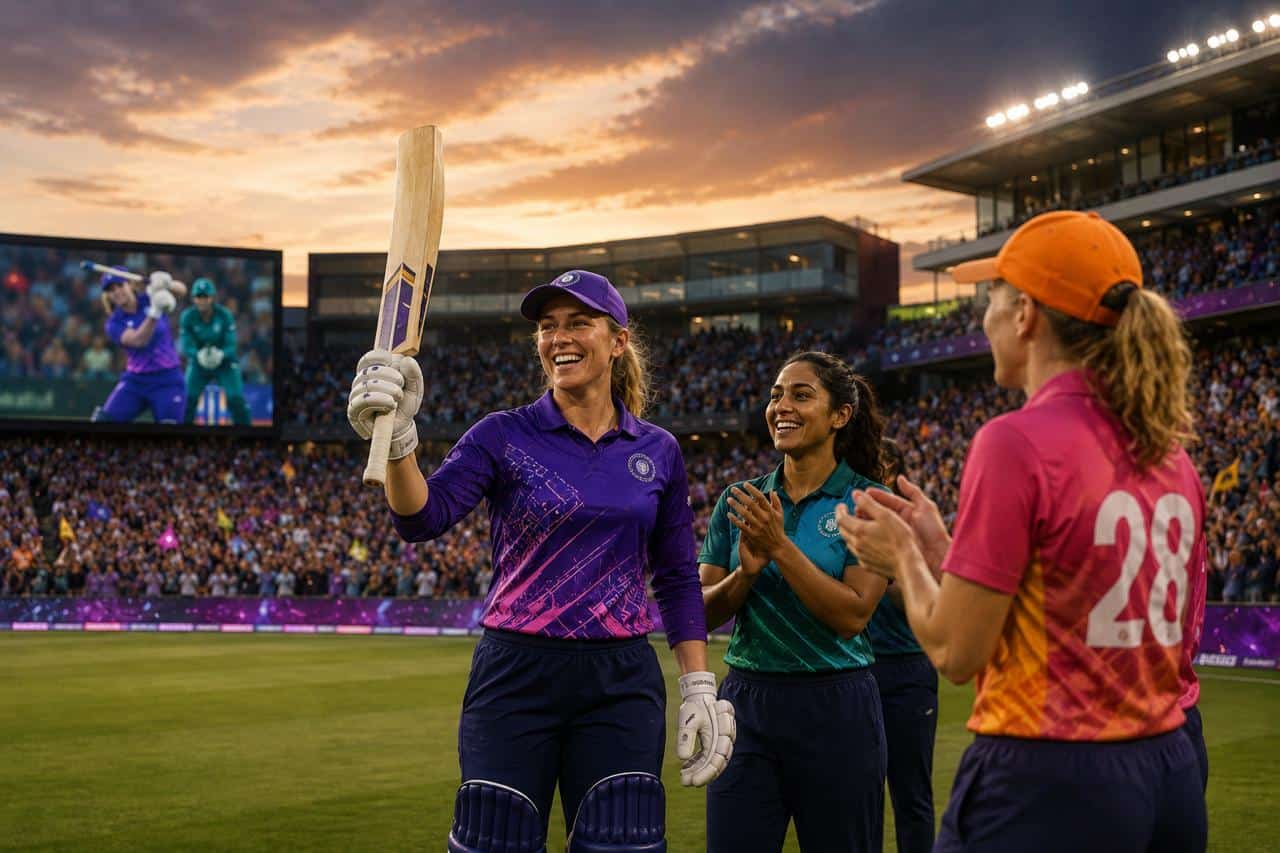
The Hundred Women’s Competition has become one of the most important developments in modern women’s cricket. Launched by the England and Wales Cricket Board in 2021, the competition was created as part of a new approach to presenting cricket to a wider audience.
Instead of treating women’s cricket as a separate product with smaller venues, limited exposure, and lower commercial attention, The Hundred placed the women’s game alongside the men’s competition in a shared match-day model. This decision helped bring women’s cricket closer to large crowds, major broadcasters, global players and serious investment, making The Hundred Women’s Competition an important case study for the growth of women’s sport.
Before the launch of The Hundred, women’s domestic cricket in England had made progress, but the path from domestic cricket to international cricket was still difficult for many players. Young players often moved from regional cricket to international matches without regularly experiencing the pressure of large crowds or major television audiences. The Hundred changed that environment by giving domestic players the chance to play alongside some of the biggest names in world cricket. Players such as Ellyse Perry, Smriti Mandhana, Marizanne Kapp and Meg Lanning brought experience and global attention, while English players gained an opportunity to develop in a much bigger setting.
The commercial impact was also clear from the beginning. The opening women’s match in 2021 between Oval Invincibles and Manchester Originals attracted 1.081 million live viewers in the UK, including 900,000 viewers on the BBC. More than seven million live broadcast viewers watched women’s matches during the first competition, showing that there was a large audience for women’s cricket when the game was presented in an accessible way. The wider effect of this change is important because, as 1xBet Analyst Karan Sharma has noted in his view of the changing sports market, women’s cricket is increasingly becoming a product that can attract new fans rather than simply sharing the existing audience of men’s cricket.
The story of The Hundred Women’s Competition is therefore about much more than a new format. It is about how cricket can build a stronger commercial model, create a better talent pathway and connect domestic teams to a growing global franchise network. Its development also shows how broadcasting, investment, player development and franchise ownership are becoming closely linked in women’s cricket. As the competition moves into a new stage, its long-term value will depend on whether these gains can continue while protecting player development and the identity of the domestic game.
The Commercial Playbook Behind The Hundred Women’s Competition
One of the biggest reasons behind the success of The Hundred Women’s Competition is its double-header model. Men’s and women’s matches are played on the same day and at the same venue, often at major cricket grounds such as Lord’s, The Oval, Edgbaston and Headingley. This gives women’s cricket access to the same facilities, crowds and match-day attention as the men’s game. It also creates a simple experience for spectators because one ticket gives them access to both matches, making it easier for fans who may not have previously followed women’s cricket to watch it.
This model has helped remove one of the biggest problems faced by women’s sport: limited visibility. A separate women’s match can sometimes struggle to attract a large audience because fans may not know about it or may not make a special trip to attend. The double-header changes that situation by placing the women’s game directly in front of an existing cricket audience. Once spectators are inside the stadium, they have an opportunity to watch the women’s match before or after the men’s match, and that can help build new interest over time.
The broadcasting model has been equally important. The Hundred has had coverage through Sky Sports and the BBC, giving the competition access to both paying viewers and a much wider free audience. The BBC has been especially important because free television removes a major barrier for people who may not already be committed cricket fans. The record audience of 1.081 million for the opening women’s match showed how powerful this combination could be when a major women’s cricket event is made widely available.
The audience numbers also point to the creation of a new market. Research from the Women’s Sport Trust and Nielsen Sports found that more than 11 million new viewers were brought into women’s sport through The Hundred and the Women’s Super League in 2021 and 2022. Around 25 percent of viewers who watched The Hundred Women’s Competition did not watch any live men’s cricket during 2021. This is important because it suggests that women’s cricket can bring in people who may not normally be part of the traditional cricket audience.
The female audience share has also been a major strength. The Hundred has regularly attracted a female audience share between 34 percent and 41 percent. This compares well with the women’s audience share for the traditional T20 Blast and Test matches, which stood at around 23 percent and 26 percent respectively in the research. These numbers show that The Hundred has been able to reach a wider group of people, including women and families who may have felt less connected to traditional cricket competitions.
Commercial growth has taken another major step through private investment. Between 2024 and 2026, the ownership structure of the eight Hundred teams began changing from a centrally controlled system towards private investment and franchise partnerships. The total portfolio value of the eight franchises has been placed at more than £975 million in the research. This level of investment gives the competition a very different financial outlook from the early years of women’s domestic cricket.
The arrival of major business groups from India and other markets has also increased the global value of the teams. London Spirit received a valuation of £296 million after a 49 percent stake was acquired for £145 million. Northern Superchargers were fully acquired by Sun TV Network for £100 million, while Oval Invincibles saw a 49 percent stake acquired by Reliance Industries for £60 million. Manchester Originals, Southern Brave and Birmingham Phoenix have also attracted major investment, showing that The Hundred is increasingly being viewed as part of the wider global cricket business.
This investment can also support the wider English cricket system. The research estimates that the private sale structure can bring more than £500 million back into English cricket, with £50 million set aside for grassroots initiatives and support for professional women’s cricket. This is one of the most important aspects of the competition’s commercial model because the value of a franchise league should not only be measured by team valuations. Its real impact should also be judged by how much money and opportunity it creates for players, coaches, academies and the next generation.
As 1xBet Analyst Karan Sharma puts it, “The real value of The Hundred is not only the money coming into the franchises, but the larger cricket economy that can grow around the women’s game.” That point is central to understanding the competition’s future. Strong commercial value can create better salaries, stronger teams, improved facilities and greater investment in young players, provided the money continues to flow into the wider system.
The Hundred as a Talent Development Platform
The commercial success of The Hundred would mean less if it did not improve the quality and depth of women’s cricket. One of the strongest arguments in favour of the competition is that it gives domestic players a much tougher environment in which to develop. Before 2021, many domestic players had limited chances to play in front of very large crowds or against the best overseas players in the world. The Hundred has helped close that gap.
Players now have the opportunity to share dressing rooms with international stars and face high-quality bowling and batting on a regular basis. A young English player can train and compete alongside experienced names from Australia, India, South Africa and other major cricket nations. This can improve both technical skills and confidence because young players are exposed to different styles of cricket and different approaches to preparation.
The pressure of playing in front of crowds of around 15,000 to 25,000 spectators is also valuable. A player who performs well in a regional competition may still need to learn how to deal with a large crowd, television coverage and the pressure of playing alongside established international stars. The Hundred provides that experience much earlier in a player’s career. This can make the move from domestic cricket to international cricket less difficult.
The competition has already been linked with the development of players such as Alice Capsey, Lauren Filer, Tilly Corteen Coleman and Mahika Gaur. These players have been able to develop in an environment where they can learn from experienced international players while also taking responsibility for their own teams. This creates a stronger bridge between youth cricket, professional domestic cricket and the England women’s team.
The wider domestic structure in England has also changed alongside the growth of The Hundred. The previous system of eight regional hubs, including teams such as Southern Vipers, Sunrisers and Northern Diamonds, was retired in late 2024. The new structure introduced three levels of First Class County cricket, with eight top-level counties operating professional women’s teams from 2025. This creates a more stable base for players before they reach the Hundred or international level.
The new top-level county structure includes a minimum of 15 fully contracted players. Each county also has a minimum salary budget of £500,000 and a salary cap of £800,000. The ECB has also introduced equal minimum starting salaries at the professional domestic level for men and women. These changes matter because talent development is difficult when players cannot make a stable living from cricket.
A professional pathway also helps young players plan their careers. Instead of seeing cricket as a short opportunity before moving into another job, players can now see a clearer route from regional and grassroots cricket into professional county cricket, The Hundred and eventually the England team. The result could be a deeper talent pool and more competition for national selection.
The Hundred therefore works best when it is viewed as one part of a larger system. It can provide the high-pressure stage, while county teams provide regular professional cricket and academies provide early development. Grassroots cricket then supplies the next group of players. If these parts continue to work together, The Hundred can remain an important part of England’s women’s cricket development.
Global Franchise Dynamics and the New Cricket Economy
The rise of The Hundred Women’s Competition cannot be understood without looking at the wider global women’s cricket market. The Women’s Premier League in India and the Women’s Big Bash League in Australia have created strong professional competitions in their own markets. The three leagues operate at different times of the year and use different formats, but they are connected through players, broadcasters, sponsors and franchise owners.
The Women’s Premier League has quickly become one of the biggest women’s cricket competitions in the world because of the size of the Indian market and the value of its media rights. The Women’s Big Bash League has a long history of developing women’s cricket in Australia and has built a strong domestic audience. The Hundred sits within this growing group of competitions and adds another major professional market for international players.
One of the biggest changes is the arrival of multi-team ownership. Major Indian cricket groups now have interests in teams across different leagues and countries. Reliance Industries, Sun Group, RPSG and GMR are examples of groups that have connections to The Hundred and the wider franchise cricket system. This means that a cricket franchise is no longer necessarily limited to one competition or one country.
Mumbai Indians provide one of the clearest examples of this model. The same wider brand network has teams and interests connected to the Women’s Premier League, Major League Cricket, SA20 and now The Hundred through MI London. This creates opportunities for players to build relationships with one organisation across several competitions. A player may therefore have access to a wider support network, coaches and commercial opportunities throughout the year.
This model could eventually lead to more year-round contracts for elite players. Instead of relying mainly on national board contracts, top players could have relationships with franchise groups that operate in several countries. Such a system could offer greater financial security and make women’s cricket more professional. It could also give franchises more control over player development and long-term planning.
However, global franchise growth also brings challenges. The cricket calendar is becoming increasingly crowded, with The Hundred, Women’s Premier League, Women’s Big Bash League, Caribbean Premier League and international cricket all competing for player time. Players cannot play every match in every competition without facing fatigue and reduced performance. Boards and franchises will therefore need to work together to manage workloads and protect player health and careers.
The growing value of women’s leagues may also create competition between cricket boards. When one competition increases salaries, other leagues may have to respond if they want to attract the same players. The Hundred’s salary growth can therefore influence the Women’s Big Bash League, the Women’s Premier League and other competitions. This competition for talent could ultimately improve financial conditions for players, but it could also create greater pressure on smaller leagues.
For The Hundred, the challenge will be maintaining its own identity while becoming part of this global system. Its 100-ball format, double-header model and English cricket setting give it a distinct identity. The competition does not need to copy the Women’s Premier League or Women’s Big Bash League to succeed. Instead, it can build value by offering something different while continuing to attract the world’s best players.
The global franchise system could also create stronger links between leagues. Players may move between competitions, coaches may work across different countries, and franchises may share ideas about marketing and player development. In that environment, The Hundred Women’s Competition can become more than an English domestic tournament. It can become one part of a global women’s cricket network.
The growing commercial interest also means that 1xBet Analyst Karan Sharma sees an important change in how women’s cricket is being positioned within the sports business. The competition is no longer being judged only on whether it can fill stadiums for a few weeks. Its value is increasingly connected to broadcasting, sponsorship, player development, franchise ownership and its ability to create fans who remain interested throughout the year.
Commercial Growth Must Support the Women’s Game
The biggest question for the future is whether commercial growth will continue to support the players and the wider cricket system. Large franchise valuations are useful because they show that investors believe there is long-term value in women’s cricket. However, the success of The Hundred should not be measured only by how much teams are worth. The more important question is whether players receive better opportunities and whether more young girls see professional cricket as a realistic career.
Broadcasting will remain one of the most important areas. The BBC has shown that free access can introduce women’s cricket to people who may never have watched it before. At the same time, paid broadcasters can provide deeper coverage and help generate rights income. Maintaining a balance between wide access and commercial value will be important as the competition develops.
Attendance is another area with room for growth. The research puts average stadium attendance at around 10,000 to 15,000 per double-header fixture. Continued marketing, better fan experiences, and strong team identities can help turn occasional visitors into regular supporters. If franchises develop strong local connections, women’s teams can build their own fan bases instead of depending entirely on the popularity of the men’s competition.
The same principle applies to sponsorship. Brands are increasingly interested in women’s sport because it can provide access to new audiences. The Hundred can offer sponsors a combination of television exposure, live events and association with a growing part of the cricket market. More sponsorship income could then support player salaries, academies, community programmes and better facilities.
Conclusion
The Hundred Women’s Competition has shown that women’s cricket can be both a sporting success and a serious commercial opportunity. Its double-header model has increased visibility, while its partnership with the BBC has helped bring the women’s game to a much wider audience. Its early viewership figures and the arrival of major private investors have shown that there is strong demand for women’s cricket when it is given the right platform. At the same time, changes to England’s domestic structure have created a stronger professional pathway for players who want to reach the highest level.
The competition has also become part of a much larger global franchise system. The growth of the Women’s Premier League and Women’s Big Bash League, combined with investment from major cricket groups, means that women’s cricket is developing into a connected international market. Players are gaining more opportunities, franchises are building global networks and domestic competitions are being pushed to improve their financial offers. The challenge will be making sure that this growth remains healthy and does not create an overloaded calendar or leave smaller competitions behind.
The future of The Hundred Women’s Competition will depend on how well it balances commercial goals with player development and fan growth. If investment continues to support grassroots cricket, professional salaries and strong domestic structures, the competition can remain a major force in women’s cricket. The wider lesson is simple, as 1xBet Analyst Karan Sharma’s assessment of the competition’s direction makes clear: the strongest sports leagues are those that turn commercial attention into lasting opportunities for players and fans. The Hundred has already helped move women’s cricket towards that model, and its next stage could determine how far that transformation can go.
