
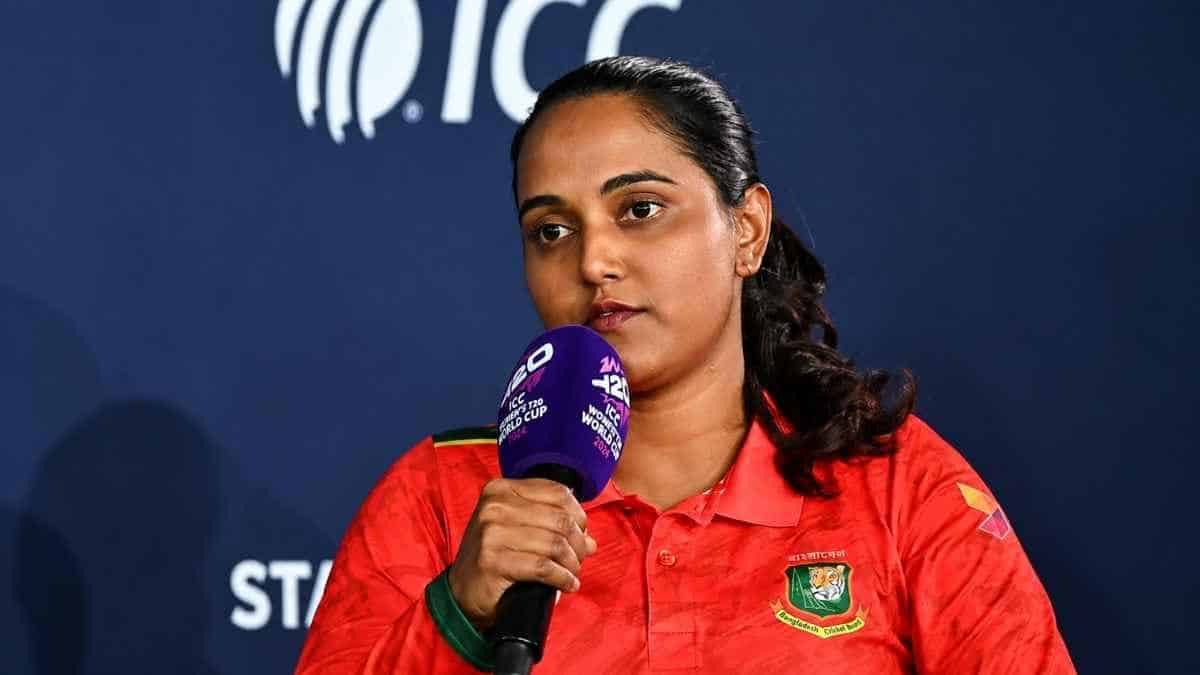
Bangladesh wicketkeeper-batter Nigar Sultana has confirmed that her decision to step down as the national women’s T20I captain was driven by a desire to concentrate on her batting rather than any disagreement with the Bangladesh Cricket Board.
Nigar had already informed the board that she intended to relinquish the T20I captaincy following the conclusion of the Asian Games campaign.
Reports had suggested she resigned after feeling unsupported during difficult periods, but the Bangladesh skipper dismissed those claims.
“No, it’s totally (false that I left because I was hurt). As a batter, as a player, I have a lot more to give to my country and my team. So I want to focus on that, and that’s why I made this decision,” Nigar told reporters after Bangladesh’s heavy defeat to India in the Asian Games semi-final.
Batting Collapse Ends Bangladesh’s Gold Medal Hopes
Bangladesh’s struggles with the bat continued as they suffered a 114-run defeat against India in the semi-final at Korogi Sports Park in Nisshin.
After choosing to bowl first, Bangladesh conceded 195/4, with Shafali Verma smashing an unbeaten 100 from just 49 deliveries to register her maiden Women’s T20I century.
The chase never gathered momentum as Bangladesh were dismissed for only 81 in 15.4 overs.
Nigar admitted the sizeable target exposed her team’s batting shortcomings.
“When you’re chasing a big total, this kind of collapse is natural. With slightly better bowling, we could have restricted them to fewer runs,” she said.
“When a team collapses for so few runs, we as batters definitely took no responsibility. If even one top-order batter had stayed till the end, we could have added more runs.”
She also noted that Sri Lanka had managed to score 107 on the same pitch earlier in the day against Pakistan.
Limited Preparation Added to the Challenge
Nigar pointed to the team’s disrupted preparations in Japan as another contributing factor.
Heavy rain restricted Bangladesh to only two days of training, while their scheduled group-stage fixture against China was abandoned and a planned warm-up match against the same opponents never took place.
“We have virtually no training facilities here. Had we played that first match against China, it would have been much better for the whole team. But we missed that opportunity too. Overall, I’ll say the entire team played very poor cricket,” Nigar said.
Bangladesh’s campaign ended without a medal after they also lost the bronze-medal playoff to Pakistan.
Head Coach Reveals Dressing Room Challenges
Following the team’s exit, Bangladesh Women’s head coach Sarowar Imran spoke openly about issues within the dressing room, suggesting uncertainty had affected performances throughout the tournament.
“You know who holds the primary responsibility (of our failure) better than I do. However, you want to frame it… you’re asking me! We weren’t in this state before. We played in World Cups under entirely different circumstances. Now, everything has suddenly shifted,” Imran said.
According to the coach, the team’s difficulties began after a narrow defeat to Sri Lanka in the Women’s Asia Cup, when speculation and reports surrounding the squad and management increased.
“Our problem actually started back in the Asia Cup. We lost a close match against Sri Lanka there. Ever since that loss, various kinds of reports and rumors have been coming out from different places… to the point that we couldn’t even score 120-130 against teams like Indonesia and the UAE. And we are still carrying that exact slump into the Asian Games,” he added.
Imran believes constant discussion over the futures of players and coaching staff created uncertainty during an important period.
“That kind of thing (negative report) can impact the team and the players. I think – I’m not entirely sure, but – it could be one of the reasons. No excuses, but it could be a factor. We just aren’t able to hit our stride; we can’t seem to reach that level at all.”
Imran Links Captaincy Decision to External Pressure
The Bangladesh coach also claimed there had been speculation during the Asian Games regarding both his own future and Nigar Sultana’s captaincy.
“Suppose it is being said about me that I won’t be retained, he won’t be retained, and things like that. This happened during a tournament… We are playing a tournament. In the middle of it, you have sidelined the head coach and the captain, so how can you expect [results]?”
Imran suggested those circumstances contributed to Nigar’s decision to relinquish the captaincy.
“My two-year contract is ending in October anyway, so I don’t have any expectations either. Criticism affects individuals on a personal level. The captain made that statement (of not continuing as T20I captain) only after all of this (negative report) happened.”
Coaching Changes Expected
Bangladesh Women’s setup now appears set for significant changes.
According to Cricbuzz, Sarowar Imran’s contract is unlikely to be renewed when it expires, with former Bangladesh men’s batting coach David Hemp emerging as the leading candidate to replace him.
Batting coach Nasiruddin Faruque is also expected to depart, with Hemp potentially taking responsibility for batting duties alongside the head coach’s role.
The expected changes could mark the beginning of a major restructuring for Bangladesh Women’s cricket following a disappointing Asian Games campaign.
