
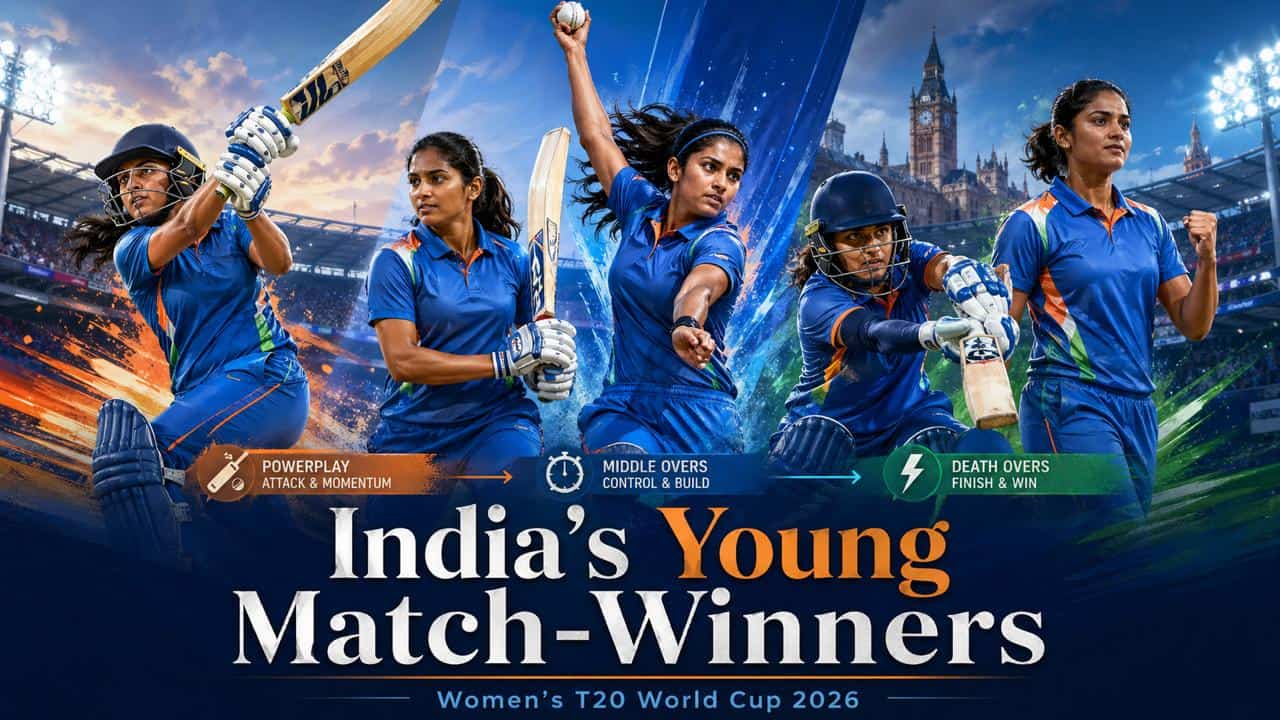
With the ICC Women’s T20 World Cup 2026 set to take place in England between June and July, India head into the tournament in a phase of recalibration. Crucially, the final squad is yet to be announced, turning recent bilateral series into high-stakes selection trials.
The India Women’s tour of South Africa 2026 offered the clearest insight into the team’s current direction. India’s 1–4 series defeat exposed structural issues, particularly middle-order instability and inconsistent bowling control, but also highlighted a growing reliance on younger players. While captain Harmanpreet Kaur led the run charts with 169 runs, the emerging core demonstrated the kind of high-impact contributions that define T20 tournaments. The material was prepared with the help of comments from 1xBet analyst Karan Sharma.
Shafali Verma
Shafali Verma scored 164 runs in the South Africa T20I series, making her one of India’s most influential batters in recent matches. More importantly, her impact comes in the powerplay, arguably the most decisive phase in T20 cricket.
When Verma attacks early, India consistently pushes towards 45–55 runs in the first six overs, a scoring range that significantly increases win probability in T20 matches. Her aggressive intent forces opposition teams to alter field placements prematurely, creating scoring opportunities for the rest of the lineup.
World Cup Role: Set the tempo early and create a scoring base that allows India to target totals above 150–160, often the difference between winning and losing in tournament conditions.
Jemimah Rodrigues
Jemimah Rodrigues has become essential to India’s middle-order structure, particularly in pressure situations. During the South Africa series, India repeatedly lost early wickets, exposing a lack of stability, something Rodrigues helped address through controlled innings.
Her strength lies in maintaining scoring momentum without taking excessive risks, often operating at a strike rate in the 120–130 range during consolidation phases. This ability to rotate strike and rebuild innings is critical in English conditions, where surfaces can slow down.
World Cup Role: Prevent collapses and bridge the gap between powerplay aggression and death-over acceleration, ensuring India maintains competitive totals even after early setbacks.
Deepti Sharma
Deepti Sharma was India’s leading wicket-taker in the South Africa series with 7 wickets, including a standout performance featuring a five-wicket haul alongside a 36-run contribution in a single match.
Her value lies in controlling the middle overs with the ball while also providing stability with the bat. In T20 cricket, the middle phase often determines whether a team builds or loses momentum, and Sharma excels in that window.
World Cup Role: Break partnerships and control run flow in the middle overs, while contributing crucial lower-order runs, effectively influencing both innings in tight matches.
Richa Ghosh
Richa Ghosh remains one of India’s most dangerous finishers, known for her ability to accelerate at a strike rate exceeding 140 in death overs. Although her South Africa series numbers were modest, her role in the team remains strategically critical.
T20 matches are frequently decided in the final 3–4 overs, where scoring efficiency matters more than volume. Ghosh’s power-hitting allows India to consistently add 30–40 runs in the final phase, turning par scores into match-winning totals.
World Cup Role: Maximise scoring in the death overs and convert competitive totals into winning ones.
Shreyanka Patil
Shreyanka Patil’s rise has been driven by strong performances in franchise cricket, including a Women’s Premier League season where she picked up 11 wickets with best figures of 5/23.
While her impact in the South Africa series was limited, her skill set remains valuable. Her off-spin offers control in the middle overs, particularly on slower surfaces, while her batting adds depth to the lower order.
World Cup Role: Provide balance as a flexible all-round option, especially useful in rotation scenarios and on pitches where spin becomes decisive.
Conclusion
India’s recent performances highlight a defining characteristic of modern T20 cricket: matches are decided not by sustained dominance, but by short bursts of high-impact play. The format rewards fast starts in the powerplay, control in the middle overs and acceleration in the death phase.
In the South Africa series, India’s struggles in the middle overs and inability to consistently finish innings exposed gaps that directly align with the roles of emerging players like Rodrigues, Sharma, and Ghosh.
With the squad still not finalised, these players are not just prospects; they are actively shaping selection decisions through performance.
“In T20 cricket, experience provides structure, but it is often the fearless execution of younger players that determines outcomes. The teams that succeed are those where emerging players deliver in decisive moments,” notes 1xBet analyst Karan Sharma.
For India, success in the Women’s T20 World Cup 2026 may ultimately depend on this new generation. The combination of Shafali Verma’s powerplay aggression, Deepti Sharma’s all-round control, and Richa Ghosh’s finishing ability creates a tactical framework where matches can be decided in key phases and by players capable of owning those moments.
