
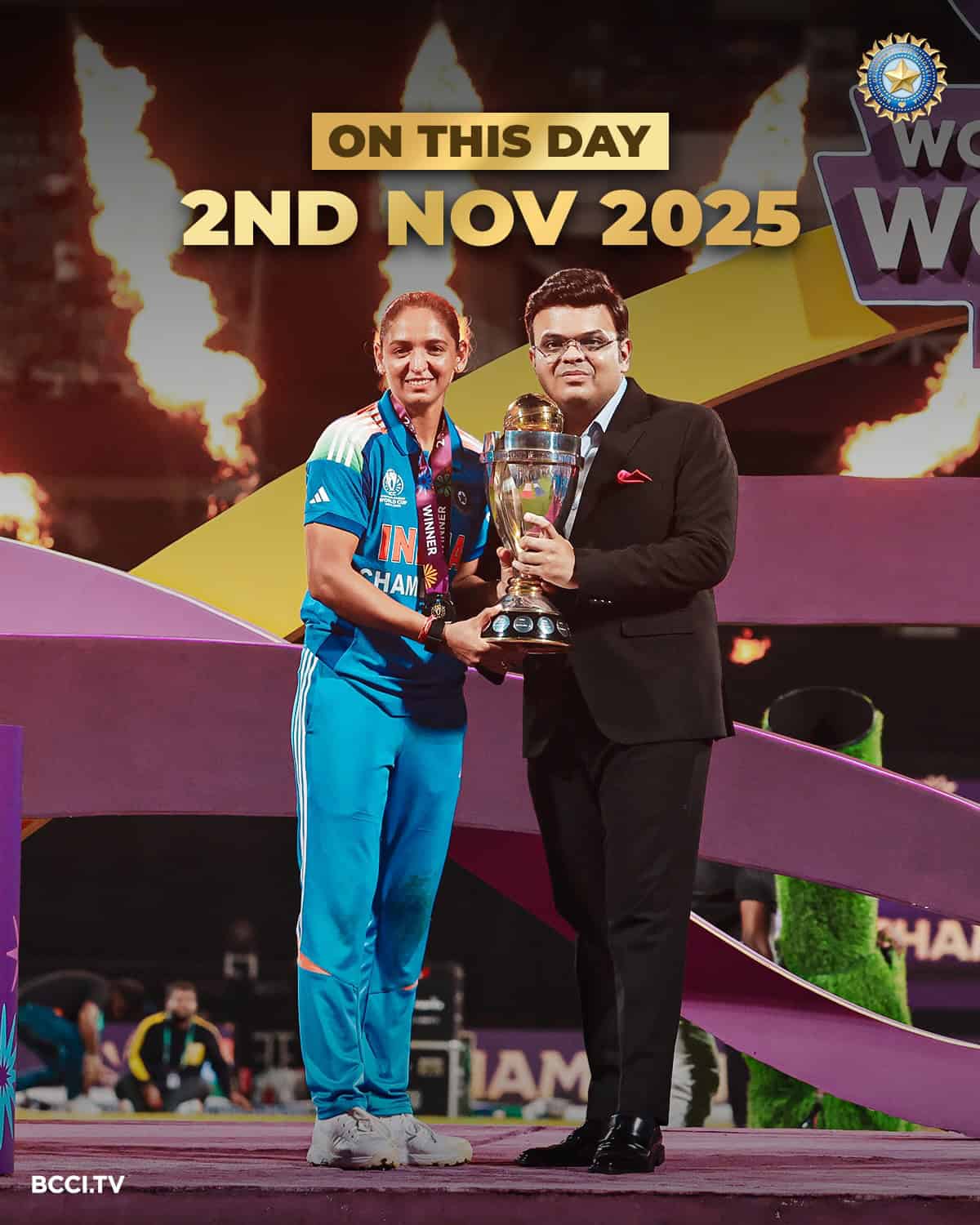
On November 2, 2026, India marks exactly one year since its historic first ICC Women’s ODI World Cup triumph. Twelve months earlier, Harmanpreet Kaur led the national team to a 52-run victory over South Africa at the DY Patil Stadium in Navi Mumbai, ending decades of disappointment and fulfilling a dream shared by generations of Indian women cricketers. India scored 298 for 7 in 50 overs before dismissing South Africa for 246 in 45.3 overs, with Deepti Sharma claiming five wickets and Shafali Verma producing a decisive all-round performance.
The achievement represented far more than a successful tournament campaign. It was the culmination of years of determination from pioneers such as Shanta Rangaswamy and Diana Edulji, followed by the contributions of Anjum Chopra, Mithali Raj and Jhulan Goswami. Their efforts helped establish the foundations on which Harmanpreet’s World Cup-winning team eventually succeeded, connecting generations of players who had pursued the same ambition under vastly different circumstances.
Mithali Raj and Jhulan Goswami Kept India’s World Cup Dream Alive
India’s journey towards World Cup glory reached an important milestone in 2005, when Mithali Raj captained the national team to its first Women’s ODI World Cup final. Her unbeaten 95 against New Zealand in the semi-final helped India advance to the title decider, demonstrating that the team could compete with the strongest opponents in international cricket. Although Australia defeated India in the final, the campaign gave Indian women’s cricket something invaluable: belief that a World Cup title was achievable.
The circumstances surrounding women’s cricket were very different two decades ago. Television coverage was limited, sponsorship opportunities were scarce, and players often competed without the financial security or professional infrastructure available today. Supporters relied heavily on newspapers, radio updates and occasional broadcasts to follow the national team, while many young girls faced resistance when expressing their ambition to play cricket. Mithali and Jhulan became central figures in changing those perceptions, inspiring future generations through their performances and determination.
India came close to fulfilling the dream again in 2017, reaching the Women’s ODI World Cup final at Lord’s under Mithali’s leadership. Harmanpreet produced an unforgettable unbeaten 171 against Australia in the semi-final, but India suffered a heartbreaking nine-run defeat against England in the title decider. Despite the disappointment, the tournament became another turning point, bringing women’s cricket greater visibility and encouraging a new generation to pursue the sport.
India’s 2025 World Cup Campaign Begins With Promise
India entered the 2025 Women’s ODI World Cup with high expectations, particularly because the tournament offered an opportunity to compete for the title on home soil. The hosts began with a 59-run victory over Sri Lanka under the Duckworth-Lewis-Stern method, scoring 269 for 8 in 47 overs before dismissing their opponents for 211. Deepti Sharma contributed 35 runs and claimed 3 for 32, providing an early indication of the all-round influence she would have throughout the competition.
India followed that performance with an 88-run win over Pakistan, scoring 247 before bowling out their opponents for 159. Kranti Gaud played an important role with the ball, returning figures of 3 for 24 from nine overs as India secured their second consecutive victory. However, the promising start was followed by a difficult period in which the team’s performances became inconsistent and qualification for the semi-finals appeared increasingly uncertain.
South Africa handed India their first defeat by successfully chasing a target of 252, winning by three wickets despite Smriti Mandhana’s 83. Australia then completed another three-wicket victory, chasing a target of 331 despite Mandhana’s century, before England defeated India by four runs. Three consecutive losses left the hosts under considerable pressure, raising doubts about whether they could recover in time to reach the knockout stage.
Smriti Mandhana and Pratika Rawal Revive India’s Campaign
India responded to their setbacks with a crucial victory over New Zealand, producing one of their strongest batting performances of the tournament. Pratika Rawal scored 122 from 134 deliveries, registering her maiden World Cup century, while Mandhana contributed 109 as India amassed 340 for 3 in 49 overs. New Zealand finished on 271 for 8 after 44 overs, giving India a 53-run victory under the DLS method and restoring confidence at an important stage of the competition.
The result strengthened India’s position in the race for the semi-finals, but their final league-stage match against Bangladesh brought another challenge. Rain prevented a result after Bangladesh had scored 119 for 9 in 27 overs and India reached 57 without loss in 8.4 overs. Radha Yadav had earlier claimed 3 for 18, but the greater concern was an injury to Rawal, who twisted her ankle and knee while attempting to field a ball near the boundary.
Rawal was subsequently ruled out of the remainder of the tournament, leaving India without a batter who had played a significant role in their recovery. Her injury created an unexpected opening for Shafali Verma, who had been outside India’s ODI plans for approximately a year. The selectors recalled the aggressive opener as an emergency replacement ahead of the knockout matches, setting the stage for one of the most remarkable comeback stories of the tournament.
Jemimah Rodrigues Leads Historic Semi-Final Chase Against Australia
India faced defending champions Australia in the semi-final, knowing they would need an exceptional performance to reach the title decider. Australia posted 338 in 49.5 overs, setting India a daunting target against a team with a formidable record in major tournaments. The challenge became even greater given India’s earlier defeat to Australia during the league stage, but the hosts responded with one of the most memorable batting performances in women’s ODI history.
Jemimah Rodrigues produced a magnificent unbeaten 127 from 134 deliveries, anchoring India’s pursuit with composure and determination. Captain Harmanpreet Kaur provided vital support with 89, and their partnership helped India maintain the required scoring rate despite the pressure of the occasion. India eventually reached 341 for 5 in 48.3 overs, completing a five-wicket victory with nine deliveries remaining.
The successful chase was the highest in women’s ODI history and the first successful pursuit of a target above 300 in a Women’s World Cup knockout match. More importantly, it eliminated the defending champions and sent India into their third Women’s ODI World Cup final. For a team that had suffered three consecutive defeats earlier in the tournament, the victory represented an extraordinary turnaround and brought the long-awaited dream of becoming world champions within reach.
Shafali Verma and Deepti Sharma Deliver in the World Cup Final
On November 2, 2025, India faced South Africa in the World Cup final at the DY Patil Stadium in Navi Mumbai. South Africa captain Laura Wolvaardt won the toss and elected to bowl, but India responded with an imposing batting performance. Shafali Verma, playing after her unexpected return to the squad, struck 87 from 78 deliveries to provide the hosts with an aggressive start. Deepti Sharma added 58 from 62 balls as India finished on 298 for 7 in their allotted 50 overs, setting South Africa a target of 299.
South Africa remained competitive throughout the chase, with Wolvaardt producing an outstanding century to keep her team in contention. The captain scored 101, but India’s bowlers continued to find breakthroughs at crucial moments. Shafali contributed two wickets, finishing with figures of 2 for 36, while Deepti delivered the decisive spell of the match, taking 5 for 39 from 9.3 overs. Her wickets prevented South Africa from sustaining their chase despite Wolvaardt’s resistance.
The defining moment arrived when Nadine de Klerk attempted an attacking shot against Deepti and sent the ball towards Harmanpreet. The Indian captain completed the catch, dismissing South Africa for 246 in 45.3 overs and sealing a historic 52-run victory. The stadium erupted as India celebrated their maiden Women’s ODI World Cup title, ending a wait that had stretched across generations of players and supporters.
Shafali was named Player of the Match for her 87 runs and two wickets, while Deepti received the Player of the Tournament award after finishing with 215 runs and 22 wickets. Her all-round contribution made her the first cricketer in men’s or women’s ODI World Cup history to score more than 200 runs and take at least 22 wickets in a single edition. The performance also established a new record for the most wickets taken by an Indian bowler in one Women’s ODI World Cup.
Smriti Mandhana and Deepti Sharma Set New Records
India’s historic triumph was accompanied by several individual milestones that reflected the team’s progress throughout the tournament. Mandhana finished with 434 runs, surpassing Mithali Raj’s previous Indian record of 409 runs in the 2017 edition. Her performances were particularly important during India’s difficult league-stage campaign, including a century against Australia and another against New Zealand when the team urgently needed a victory.
Mandhana also reached significant career milestones during 2025, becoming the fastest and youngest player in women’s cricket to reach 5,000 ODI runs and the first Indian woman to score 1,000 ODI runs in a calendar year. Her consistency at the top of the order provided India with a reliable foundation, while the contributions of Rodrigues, Harmanpreet, Shafali and Deepti demonstrated the depth of the team’s batting and all-round resources.
Deepti’s 22 wickets and match-winning performance in the final were equally important to India’s success. Her ability to contribute in different phases of the game made her one of the tournament’s most influential players, while her five-wicket haul against South Africa delivered the decisive breakthroughs. Together, the individual performances highlighted how India’s victory was built on contributions from across the squad rather than reliance on a single player.
Harmanpreet Kaur Fulfils the Dream of Earlier Generations
For Harmanpreet, the World Cup triumph carried special significance because she had experienced the disappointment of India’s defeat in the 2017 final. Eight years later, she returned to the biggest stage as captain and led the team to the title that had eluded previous generations. Her leadership throughout the tournament, particularly during India’s recovery from three consecutive defeats, became an important part of the team’s success.
The celebrations after the final reflected the wider significance of the achievement. Former players, including Mithali Raj, Jhulan Goswami, Anjum Chopra and Reema Malhotra, were present as India’s new generation celebrated with the trophy. The moment brought together cricketers who had competed under very different circumstances but shared the same ambition of seeing India become world champions.
For Mithali and Jhulan, the victory represented the fulfilment of a dream they had pursued throughout their international careers. Their contributions, alongside those of earlier pioneers such as Diana Edulji and Shanta Rangaswamy, had helped establish the foundations for the modern women’s game in India. The World Cup title was therefore not simply a reward for the players who competed in 2025, but also a recognition of the generations who had worked to create opportunities for those who followed.
First Anniversary Highlights India’s Lasting World Cup Legacy
On November 2, 2026, exactly one year after Harmanpreet lifted the trophy in Navi Mumbai, India’s maiden Women’s ODI World Cup victory remains a defining moment in the country’s sporting history. The campaign combined early victories, difficult defeats, a major injury setback, an unexpected comeback and a record-breaking semi-final chase before culminating in victory over South Africa. Each stage contributed to a story of resilience that made the final result particularly meaningful.
The anniversary also offers an opportunity to recognise how far Indian women’s cricket has progressed since the days when players struggled for visibility, resources and professional opportunities. The success of Harmanpreet’s team was built on the efforts of earlier generations, while the performances of younger players such as Shafali and Rawal offered encouragement for the future. With women’s cricket attracting growing attention and investment, India’s World Cup victory established a new standard for what the national team could achieve.
Exactly one year after that unforgettable night, the image of Harmanpreet completing the final catch remains a symbol of Indian women’s cricket’s long journey towards global success. From Mithali Raj’s unbeaten 95 in the 2005 semi-final to the title-winning moment in 2025, the dream survived decades of setbacks and near misses before finally becoming reality. The first anniversary is therefore more than a celebration of a trophy; it is a tribute to every generation that helped make India’s historic victory possible.
