
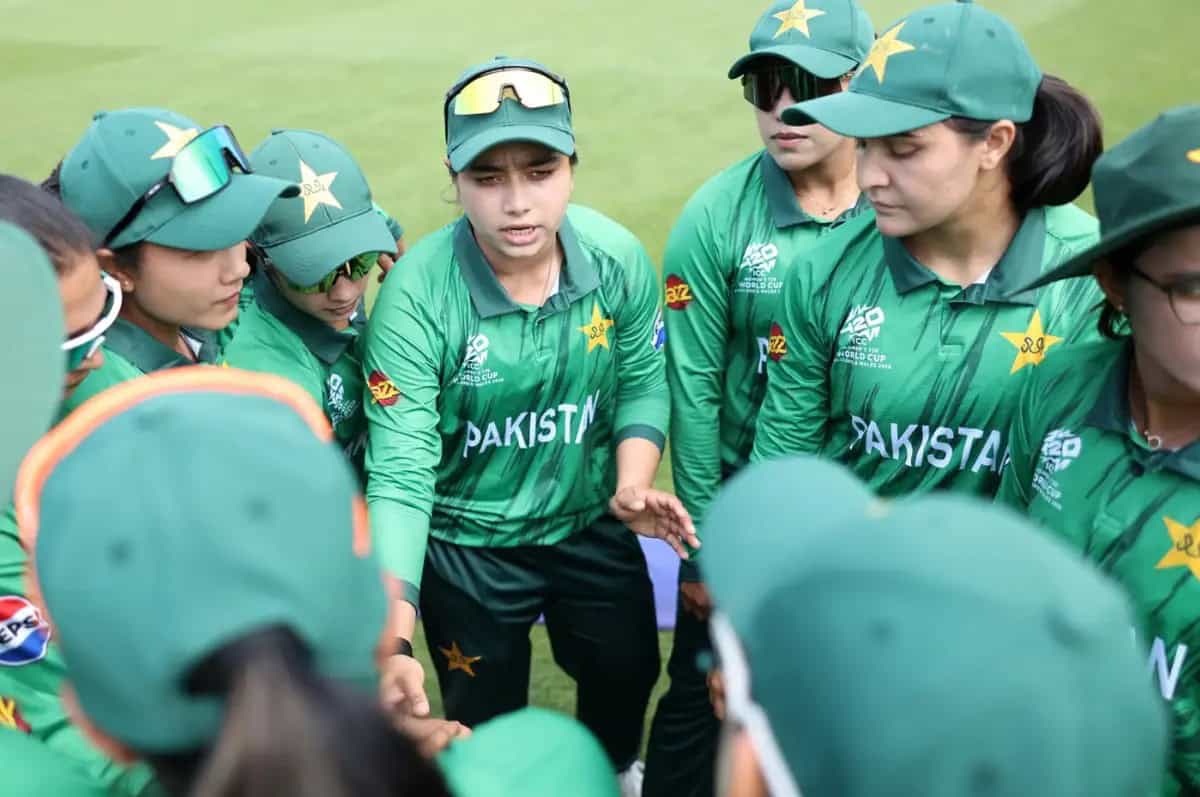
Pakistan have qualified for the Super Six stage of the ICC Women’s Emerging Nations Trophy, winning three of their four Group B matches. Their only defeat, against the Netherlands, has exposed familiar concerns about consistency. The Pakistan Cricket Board’s (PCB) decision to replace head coach Wahab Riaz with Shane Deitz during the tournament has further intensified scrutiny of the team’s direction.
Despite promising performances in 2026, Pakistan have struggled against stronger opponents and in major tournaments. Their dependence on captain Fatima Sana, inconsistent batting and difficulties chasing targets present significant challenges for the new coaching setup.
Pakistan Women’s Inconsistent Results Raise Concerns
Pakistan began 2026 with encouraging performances during their tour of South Africa. Although they lost both the three-match T20I and ODI series 2-1, their batting and bowling showed signs of improvement against strong opposition. They subsequently dominated Zimbabwe at home, completing 3-0 series victories in both formats and appearing to build momentum ahead of the Women’s T20 World Cup.
However, their preparations suffered setbacks when they lost to Ireland and the West Indies in a T20I tri-series before the World Cup. Warm-up defeats against Sri Lanka and Scotland further exposed weaknesses that carried into the tournament itself. Pakistan managed only one victory in five group-stage matches, defeating the Netherlands in a contest where their bowlers compensated for a batting performance that produced just 126 for 6.
The difficulties continued after the World Cup. Pakistan lost both their ODI and T20I series against Sri Lanka by 2-1 margins before suffering semifinal defeats to the same opposition at the Women’s Asia Cup and Asian Games. These results highlighted the team’s inability to sustain its early-season momentum when competing in major tournaments.
Across 28 Women’s T20 Internationals in 2026, Pakistan recorded 13 victories, 14 defeats and one no-result. Nine of those wins came against Zimbabwe, Thailand, the Netherlands and Hong Kong, with four against Zimbabwe, three against Thailand and one each against the other two teams. While those results demonstrated Pakistan’s ability to overcome lower-ranked opponents, their record against stronger sides remained a significant concern.
The pattern suggests that Pakistan’s main challenge is not a complete lack of talent but an inability to maintain performance levels across different opponents and match situations. Their qualification for the Emerging Nations Trophy Super Six stage represents progress, although the defeat to the Netherlands reinforced questions about whether the team can consistently deliver against competitive opposition.
Shane Deitz Replaces Wahab Riaz Amid Coaching Uncertainty
The PCB’s decision to appoint Shane Deitz as head coach during the Emerging Nations Trophy has placed renewed attention on Pakistan’s coaching structure. Deitz replaces Wahab Riaz, who initially joined the women’s setup as a mentor in July 2025 before becoming head coach following Muhammad Wasim’s departure after the ODI World Cup.
Riaz took charge ahead of the South Africa tour at the beginning of 2026 and oversaw encouraging performances against the Proteas and Zimbabwe. However, Pakistan’s subsequent struggles at the T20 World Cup, Women’s Asia Cup and Asian Games weakened confidence in the team’s progress. His tenure lasted approximately 11 months, raising questions about whether the coaching staff had sufficient time to implement lasting changes.
Throughout his time in charge, Riaz encouraged an aggressive batting philosophy and repeatedly emphasised the importance of positive cricket. Following Pakistan’s defeat to India at the T20 World Cup, he reiterated that the team needed to maintain a fearless approach rather than retreat into defensive play. Although that intent was occasionally evident, Pakistan struggled to execute it consistently against stronger bowling attacks.
The appointment of Deitz represents another attempt to establish a more effective long-term structure. However, repeated coaching changes alone are unlikely to resolve problems that have persisted across several tournaments. Pakistan will need a clearer tactical identity, improved player development and greater consistency in selection and execution to translate their potential into sustained results.
Pakistan’s Heavy Dependence on Fatima Sana
Pakistan’s bowling attack has traditionally relied heavily on spin, but their dependence on captain Fatima Sana for pace bowling has become increasingly evident. Across 28 Women’s T20 Internationals in 2026, Pakistan claimed 188 wickets, with spinners accounting for 108 and pace bowlers taking 48.
Fatima contributed 31 of the 48 wickets taken by Pakistan’s pacers, maintaining an economy rate of 7.35. The other seven pace bowlers used during the year managed just 17 wickets between them, conceding runs at an economy rate of 9.42. This imbalance placed considerable responsibility on Fatima to provide breakthroughs while controlling the scoring rate.
Her batting contributions have been equally important. Fatima accumulated 540 runs in Women’s T20 Internationals during 2026 at an average of 45 and a strike rate of 149.58, including three half-centuries. Much of that success came while batting at No. 6 or No. 7, where she frequently had to accelerate the innings or recover from earlier setbacks.
However, her performances were less dominant in the year’s three major tournaments. Across the T20 World Cup, Women’s Asia Cup and Asian Games, Fatima scored 242 runs in 12 innings at an average of 30.25 and a strike rate of 120.39, registering one half-century. The decline reflected the greater difficulty of maintaining her attacking effectiveness against stronger opponents and under tournament pressure.
Pakistan’s other batters have also struggled to provide consistent support. Muneeba Ali, one of the team’s senior players and its captain during the Emerging Nations Trophy, averaged 25.69 at a strike rate of 113 across 25 Women’s T20I innings in 2026. For an opening batter who regularly has access to the Powerplay fielding restrictions, those figures underline the need for more effective scoring at the top of the order.
Pakistan’s dependence on a small group of established performers has limited their ability to respond when key players struggle. Developing additional pace-bowling options and improving the batting unit’s collective contribution will therefore be essential to building a more balanced team.
Batting Second Continues to Challenge Pakistan Women
Pakistan’s difficulties have also been evident in run chases. According to the season figures, they scored 3,984 runs across 28 Women’s T20 Internationals in 2026 at an overall run rate of 7.53, but their performances varied considerably depending on whether they batted first or second.
In 21 innings batting first, Pakistan accumulated 3,169 runs at a run rate of 7.74, averaging approximately 151 runs per innings. They won 10 of those matches, demonstrating a greater ability to establish competitive totals when setting targets.
Their record while chasing was less convincing. Pakistan won only three of seven matches batting second, losing the remaining four. They scored 785 runs in those innings at a run rate of 6.79, averaging approximately 112 runs per chase.
The contrast suggests that Pakistan have struggled to maintain scoring momentum when pursuing targets. Although the figures do not account for differences in opposition strength or the size of individual targets, they highlight an area requiring attention. Improving strike rotation, reducing dot-ball pressure and developing more reliable partnerships could help the team become more effective when batting second.
Shane Deitz Faces Major Rebuilding Task Ahead of 2028 World Cup
Deitz arrives with international coaching experience, having previously worked with the West Indies women’s team and held coaching roles involving Bangladesh and the Netherlands. The former Australian first-class cricketer and Vanuatu player-coach also worked as a high-performance coach with Cricket Wellington in New Zealand between 2008 and 2013.
His first assignment will be Pakistan’s upcoming bilateral series against the West Indies, where he is expected to join the squad in the Caribbean. The tour will provide an opportunity to assess the team’s weaknesses and begin implementing his approach ahead of the 2028 Women’s T20 World Cup, which Pakistan are scheduled to host.
Pakistan’s priorities are clear: strengthen the batting lineup, develop additional pace-bowling options, reduce the burden on Fatima Sana and improve their record when chasing. Their Super Six qualification offers encouragement, but sustained progress will depend on addressing these weaknesses rather than relying on coaching changes or isolated individual performances.
