
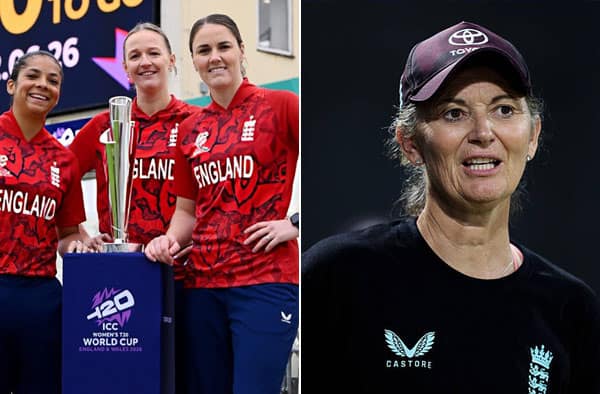
England head coach Charlotte Edwards has described the process of finalising the squad for the ICC Women’s T20 World Cup 2026 as one of the most demanding tasks of her tenure, with increased depth creating a highly competitive selection environment.
“It’s probably going to be one of the hardest teams, certainly, I’ll have to pick, or we’ll have to pick as the selection group,” Edwards said, underlining the scale of the challenge.
Growing Depth Creates Selection Dilemmas
England’s expanding talent pool has played a central role in making selection more complex. A recent 30-player training camp in South Africa highlighted the range of options available, with players such as Davina Perrin, Tilly Corteen-Coleman and Jodi Grewcock impressing during intra-squad matches.
Their performances have intensified competition for places, placing additional pressure on established members of the squad and reshaping the selection landscape.
Edwards acknowledged how this marks a shift from previous years. “But equally, what England have probably had to pick over the last sort of 10 years, there is a real depth of talent now and players performing week in, week out,” she said.
Balancing Experience and Youth
The final squad is expected to reflect a careful mix of experienced players and emerging talent, with younger cricketers pushing strongly for inclusion. The presence of uncapped players in contention highlights the progress made in England’s domestic structure and the broader professionalisation of the women’s game.
Despite the complexity, Edwards sees the situation as a positive development. “That’s where we wanted to be coming into this. It certainly makes our jobs as selectors really, really hard. But I’d certainly rather it be like that than having easy calls to make going into a World Cup,” she said.
Emphasis on Fitness and Standards
Beyond on-field performance, selection decisions are also being shaped by fitness, discipline and professionalism. Since taking charge, Edwards has introduced minimum fitness benchmarks aimed at raising individual and team standards.
These measures have contributed to noticeable improvements in fielding and physical conditioning, fostering a more competitive environment where consistent performance is essential to secure a place in the squad.
Preparation and Recent Form
England’s recent results have reflected a team in transition. Early series victories against West Indies were followed by more testing encounters against India and a semi-final exit in the 50-over World Cup, highlighting areas for further development.
The winter training period has been used to build cohesion and refine roles, while upcoming home series against New Zealand and India will offer players a final opportunity to strengthen their case for selection.
A Home World Cup Opportunity
With the tournament set to be played in England, the significance of the occasion has not been lost on the squad.
“When I first took on this job, I knew exactly what was ahead of us,” Edwards said. “Home World Cup, and I’ve said it to the players: this comes once in your lifetime, in terms of career.”
Reflecting on what success would mean, she added: “It would be just the most unbelievable feeling. Having experienced it myself as a player, and a number of the players who are going to be hopefully in this team experienced 2017, you really understand the enormity of what you can do for the sport, the memories you’ll create yourself as well.”
Final Decisions Loom
As the selection process approaches its conclusion, England’s strength lies in its depth, even if it brings difficult choices. The final squad is expected to combine proven performers with emerging prospects, as Edwards and her panel aim to assemble a team capable of challenging for the title on home soil.
