
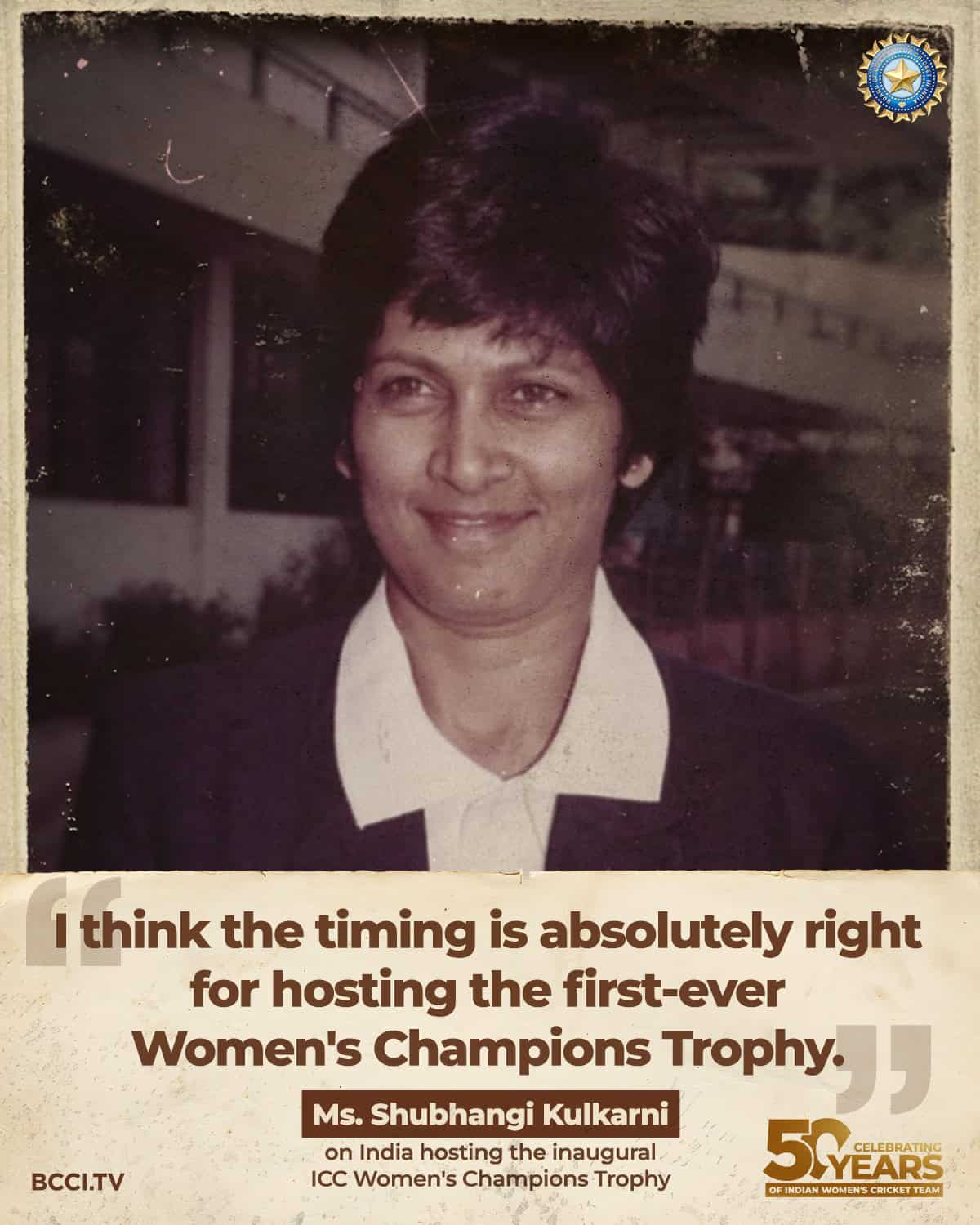
Former India captain Shubhangi Kulkarni has reflected on five decades of Indian women’s international cricket, recalling the team’s historic Test debut in 1976, the challenges faced by its early players and the remarkable progress that culminated in India’s maiden ICC Women’s Cricket World Cup title in 2025.
October 31, 2026, marked 50 years since India played their first official women’s international match against the West Indies at the M. Chinnaswamy Stadium in Bengaluru. Among the 11 players who made history that day was 17-year-old leg-spinner Kulkarni, who went on to become one of India’s most accomplished Test bowlers.
Speaking to BCCI.tv, Kulkarni recalled the excitement of representing India for the first time, the overwhelming support during the team’s maiden Test victory in Patna and the transformation of women’s cricket from a largely amateur sport into a professional environment.
Shubhangi Kulkarni Recalls India’s Historic Test Debut in 1976
India’s first women’s international match began on October 31, 1976, against the West Indies in Bengaluru, opening a six-Test series that would establish an important foundation for the sport in the country.
Kulkarni was just 17 years and 104 days old when she made her debut, becoming the third-youngest player in Women’s Test history at the time.
“All of us were very excited,” she recalled.
“We were all very young, mostly college-going girls around 17 or 18 years old. We were just getting exposed to international competition, and all of us were thrilled to be playing international matches.”
India prepared for the series under the guidance of former men’s Test captain Lala Amarnath. Kulkarni remembered the challenge of facing a West Indies side known for its pace bowling, while India relied heavily on the strength of its spin attack.
The young leg-spinner made an immediate impact, claiming five wickets for 48 runs in her first international innings. She finished the match with figures of 7 for 76.
“The first Test match was very memorable for me because I got five wickets,” Kulkarni said. “It was the first time I was bowling to international cricketers. I had just learned a few tricks and was trying them out.”
Her performance marked the beginning of a 15-year international career in which she became a central figure in India’s bowling attack.
India’s First Test Victory in Patna Remains a Special Memory
One of the defining moments of the 1976 series came during the fourth Test at Moin-ul-Haq Stadium in Patna, where India registered their first victory in international women’s cricket.
Kulkarni played an important role with the ball, taking 3 for 43 and 4 for 14 as India secured the historic win.
She finished the six-match series with 23 wickets, a tally that remains a joint record for the most wickets taken in a Women’s Test series.
However, the former India captain remembers the reaction of the spectators as vividly as the performances on the field.
“The kind of response we got from the crowd was something we had never anticipated,” she said.
Around 30,000 spectators attended the match, creating an atmosphere that surprised the players.
“After we won, the crowd response was so overwhelming that it took us a long time to get back to the hotel because the crowds wouldn’t allow the bus to move. We kept signing autographs.”
The reception demonstrated the growing public interest in women’s cricket, even as players continued to face considerable challenges away from the field.
Early Indian Women Cricketers Faced Financial and Social Barriers
Kulkarni explained that women’s cricket in India initially struggled to gain acceptance, with some spectators attending matches simply out of curiosity.
“Initially, people came out of curiosity just to see us play. But once they started watching, they appreciated our skills and realised that girls could play cricket too.”
For many aspiring players, the first obstacle was securing permission from their families.
“The biggest challenge for most girls was getting permission from home to play cricket,” she recalled.
Parents were often concerned about injuries from the hard leather ball and the effects of spending long hours playing outdoors.
Financial difficulties created further barriers. Players frequently paid their own travel expenses, stayed in dormitories and travelled in unreserved or second-class train compartments.
“Another major challenge was funding. We had to spend money from our own pockets to travel for domestic events, often paying our own train fares,” Kulkarni explained.
Despite these limitations, the early generations continued competing and helped build the domestic structure that supported India’s international development.
Shubhangi Kulkarni’s Records in Women’s Test Cricket
Kulkarni established an impressive international record during a career that included 17 consecutive Test appearances for India.
The leg-spinner claimed 60 wickets in Women’s Tests, including five five-wicket hauls, a tally that stands as a joint world record.
She delivered 3,329 balls during her Test career, placing her among the leading bowlers in the format by workload. Her bowling also resulted in 16 stumpings, the second-highest tally recorded in Women’s Test cricket.
Kulkarni contributed in One-Day Internationals as well, taking 38 wickets with a bowling strike rate of 30.2 and an economy rate of 3.49.
Her batting produced another memorable performance during her captaincy debut against England at Collingham in 1986.
With India struggling at 105 for 5, Kulkarni helped rebuild the innings alongside Minoti Desai. The pair added 106 runs for the eighth wicket, one of the highest partnerships for that wicket in Women’s Test history.
Kulkarni scored a career-best 118 as India reached 323, demonstrating her value as an all-round cricketer.
Her achievements were recognised with the Arjuna Award in 1985.
Kulkarni Highlights the Importance of the 2006 BCCI Merger
Kulkarni continued contributing to Indian women’s cricket after her playing career, serving as Honorary Secretary of the Women’s Cricket Association of India (WCAI).
She played an important role during the organisation’s merger with the Board of Control for Cricket in India (BCCI) in 2006, a development that significantly changed the administration and financial support available to women cricketers.
Kulkarni credited former BCCI president Sharad Pawar for helping bring women’s cricket under the Board’s administration.
“That is where things changed for women’s cricket in India and that is when the girls started getting the facilities,” she said.
The former captain contrasted the limited resources available during her playing days with the infrastructure provided to current players.
“The facilities that the BCCI is providing to women cricketers are excellent now,” she said.
She highlighted improvements in playing surfaces, accommodation, travel arrangements, central contracts and match fees, explaining that modern players can concentrate on cricket without facing many of the financial difficulties experienced by earlier generations.
Kulkarni also acknowledged the contributions of former BCCI Honorary Secretary and current ICC Chairman Jay Shah, alongside the Board’s administration, in supporting the development of women’s cricket.
Women’s Premier League Creates New Opportunities
Kulkarni identified the introduction of the Women’s Premier League as another major turning point for Indian cricket.
The competition has provided domestic players with opportunities to compete alongside established international cricketers and gain experience in a professional environment.
“The most significant change has been the introduction of the Women’s Premier League (WPL), which has opened up numerous opportunities for domestic players to play alongside international stars and learn from them in the dressing room,” she said.
The league has become an important part of India’s women’s cricket structure, complementing improvements in domestic competitions and national-team facilities.
For Kulkarni, these developments demonstrate how far the sport has progressed since players were required to fund their own travel and compete on uneven grounds.
India’s 2025 World Cup Triumph Fulfils a Long-Held Dream
India’s victory in the ICC Women’s Cricket World Cup final against South Africa on November 2, 2025, represented a particularly emotional milestone for Kulkarni and her former teammates.
Led by Harmanpreet Kaur, India secured their maiden Women’s ODI World Cup title, fulfilling an ambition shared by generations of players.
“It was a dream come true for most of us former players because winning a World Cup is something we all wanted,” Kulkarni said.
“Seeing this team achieve it gave me immense satisfaction.”
She praised the players for their determination throughout the tournament and highlighted the collective effort behind the achievement.
“The team performed exceptionally well; they gave their 100% and never gave up. There were challenges, but they overcame them, making it a total team effort.”
Kulkarni also appreciated the recognition given to former players by members of the World Cup-winning team.
“It is very nice of the current players to appreciate and recognise the efforts of the earlier players,” she said.
“During our time, we played for the love and passion of the game. It felt like they truly valued all of that.”
Kulkarni Pays Tribute to the Founders of Women’s Cricket in India
As Indian women’s cricket celebrated its 50th international anniversary, Kulkarni emphasised the importance of recognising those who helped establish the sport’s early administrative structure.
She highlighted the contributions of Mahendra Kumar Sharma, Pramila Bai Chavan and Chandra Tripathi, who played important roles in developing organised women’s cricket in India.
Kulkarni recalled the establishment of the Women’s Cricket Association of India in 1973 as a crucial step in creating opportunities for female cricketers.
“In 1973, when the organisation was formed and Mr Sharma registered it, he actually gave the girls a platform to play a sport and turn what had been a hobby into a national sport,” she said.
Their efforts helped create the foundation for the domestic competitions and international opportunities that followed.
Kulkarni Welcomes Inaugural Women’s Champions Trophy in India
Looking ahead, Kulkarni welcomed India’s selection as host of the inaugural ICC Women’s Champions Trophy, scheduled for February 2027.
She believes the country’s growing cricket infrastructure, expanding fan base and recent international success make it an appropriate venue for the new competition.
“I think the timing is absolutely right for hosting the first-ever Women’s Champions Trophy,” she said.
Kulkarni pointed to India’s 2025 World Cup victory and the growing popularity of women’s cricket as encouraging signs for the sport’s future.
“I think it’s most appropriate that we have the inaugural edition in India. And I think it’s a great initiative by ICC to start this tournament.”
For Kulkarni, the contrast between 1976 and 2026 reflects decades of perseverance by players, administrators and supporters.
“Those were challenging times. But looking back at where we are today, it gives us a sense of satisfaction that what we did in the beginning has borne fruit.”
As Indian women’s cricket enters its next half-century, her reflections highlight both the sacrifices of its pioneers and the opportunities now available to future generations.
