
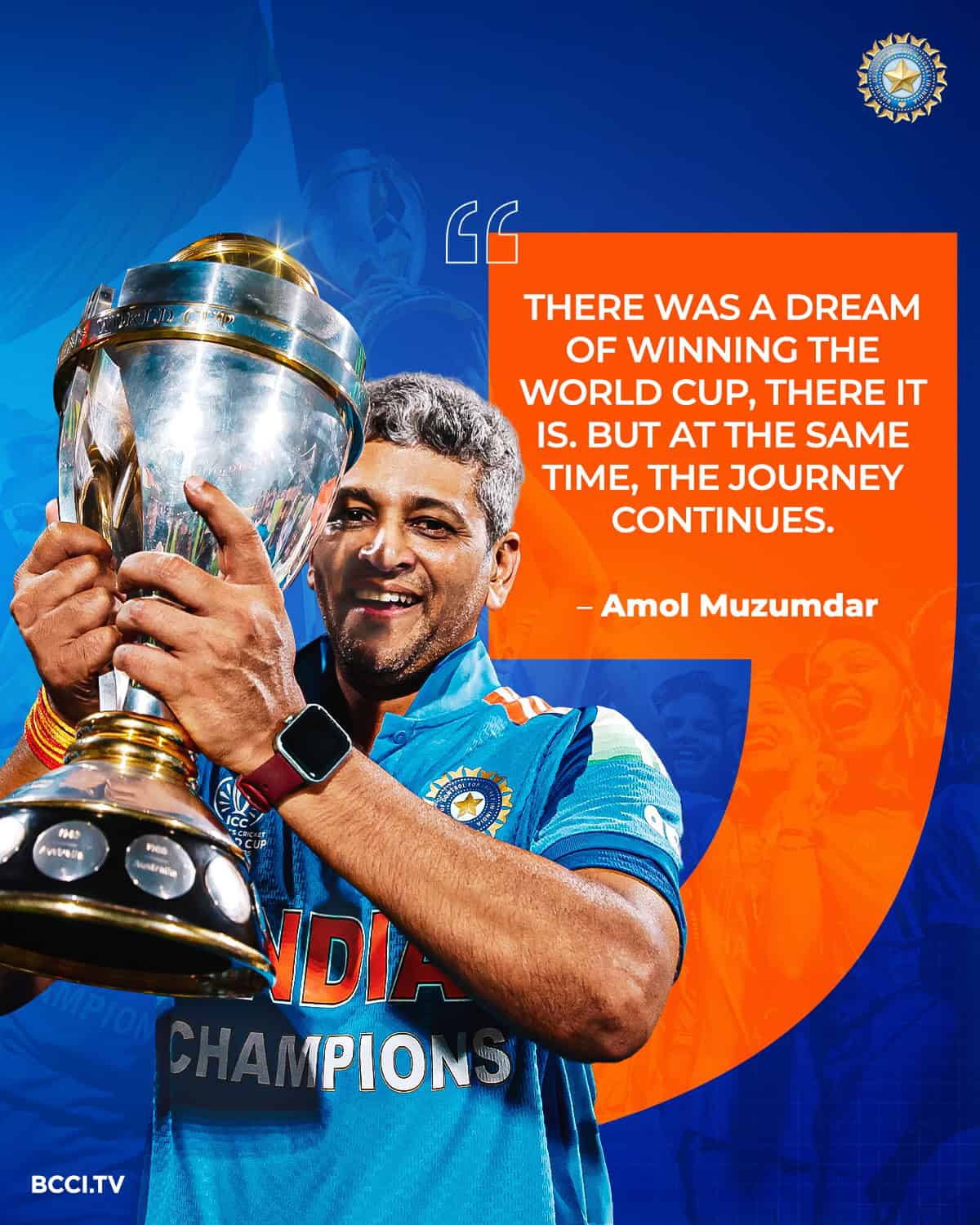
India women’s head coach Amol Muzumdar has revealed that the national team is moving towards establishing a dedicated T20I squad, with an emerging generation of talented cricketers providing the foundation for a more specialised approach to the shortest international format. The former Mumbai batter believes India’s expanding talent pool, improved development programmes and greater emphasis on fitness and professionalism have created favourable conditions for the transition.
Speaking about the possibility of India fielding a separate T20I group, Muzumdar suggested that the change could happen sooner rather than later. His comments come during an important period for Indian women’s cricket, with Smriti Mandhana beginning her tenure as all-format captain and the team preparing for the inaugural ICC Women’s T20 Champions Trophy, scheduled to take place in India from February 14 to 28, 2027.
Amol Muzumdar Confident About India’s Emerging T20I Talent
Asked how soon India could establish a dedicated T20I squad, Muzumdar offered an encouraging assessment of the country’s developing talent. He highlighted the quality of young players coming through the BCCI’s Centre of Excellence (CoE), where national age-group camps have become an important part of identifying and preparing future international cricketers. According to the head coach, the progress being made at the grassroots level indicates that Indian women’s cricket has the depth required to consider a more specialised T20I setup.
“Not long,” Muzumdar said when asked about the timeline. “We’re already on that path. There’s some amazing talent coming through. The talent I’ve seen at the CoE, where they hold the India Under-15 and U-19 camps, is terrific. The work at the CoE is superb. The camps are a good reflection of where Indian women’s cricket is at the moment. I’m sure it’s in a healthy state.”
Muzumdar believes the biggest improvement among younger players is not limited to their cricketing ability. He has been particularly impressed by their understanding of the physical and professional demands of modern cricket, including nutrition, fitness, fielding and athletic preparation. These qualities, he suggested, are becoming part of player development from an early age, allowing emerging cricketers to approach the international game with greater awareness of what is required.
“They are tuned in. They are professionals. Even the U-15 players are professionals. They understand the nutrition aspect of the game. They understand the fitness aspect of the game. They understand fielding. They’re terrific fielders. They’re good athletes. They understand that athleticism is key in cricket,” he explained.
Smriti Mandhana Begins New Era as India Women’s Captain
Muzumdar’s comments come during a significant leadership transition in Indian women’s cricket. Harmanpreet Kaur stepped down as captain across all formats on October 6, 2026, with Smriti Mandhana appointed as her successor later that day. The change followed a successful period for the national team, highlighted by India’s historic victory in the ICC Women’s ODI World Cup in November 2025, and marked the beginning of a new chapter under Mandhana’s leadership.
Mandhana’s first assignment as full-time captain was India’s maiden bilateral white-ball series against Zimbabwe, featuring three T20Is and three ODIs. India completed a 3-0 clean sweep in both formats, providing an encouraging start to the new leadership era. The victories also offered the coaching staff an opportunity to assess the squad’s depth and evaluate players who could become important members of India’s future T20I plans.
Having worked closely with Harmanpreet for three years, Muzumdar expressed appreciation for the former captain’s contribution while acknowledging the opportunities presented by the transition. He praised her leadership and professionalism, describing their working relationship as an important part of his coaching experience.
“I had a very good time with Harman as a captain. But I’m also looking forward to the future. With utmost respect, the manner in which she conducted herself as a captain, as a skipper, was superb,” Muzumdar said. “I feel myself really lucky that I had that opportunity for the three years that I spent with her as a coach.”
India’s 2025 World Cup Triumph Built on Team Unity
India’s transition towards a more specialised T20I structure comes a year after the national team achieved its biggest milestone in women’s ODI cricket. On November 2, 2025, India defeated South Africa by 52 runs in the ICC Women’s ODI World Cup final at DY Patil Stadium in Navi Mumbai, securing their maiden title in the competition. The victory represented the culmination of years of development and established a new benchmark for the national side.
Reflecting on the factors behind that success, Muzumdar identified the atmosphere within the dressing room as one of the most important elements of India’s World Cup-winning campaign. While individual performances and tactical preparation were essential, he believes the players’ unity helped create an environment in which the team could handle pressure and maintain confidence throughout the tournament.
“If I have to pinpoint just one, then I think the unity in the camp and the dressing room atmosphere. Because of that unity, the dressing room atmosphere was very light. There was a little bit of a buzz around in the dressing room, which I love to create,” he said.
Muzumdar explained that his approach to team culture was influenced by his playing career with Mumbai, particularly the successful teams of the 1990s. The energy and togetherness he experienced in those dressing rooms shaped his understanding of how successful teams function, and he has sought to bring similar qualities into the Indian women’s setup. Maintaining that environment will remain an important priority as the team introduces younger players and develops a stronger T20I squad.
Muzumdar Emphasises Communication and Player Development
Beyond identifying talented players, Muzumdar believes effective coaching requires an understanding of individual personalities and the appropriate moments to offer guidance. He places considerable importance on observing players’ body language and assessing their willingness to receive feedback before initiating conversations about performance or improvement.
The India head coach explained that technical knowledge alone is not enough to develop international cricketers, particularly when working with players who have different levels of experience and confidence. Understanding how to communicate with each individual can help create an environment in which players feel comfortable learning and adapting to new demands.
“As a coach, you need to understand when to say, how to say and what to say,” Muzumdar explained.
This philosophy could become particularly important as India move towards a dedicated T20I setup. Integrating emerging players into the international environment will require the coaching staff to balance individual development with the team’s competitive objectives, while preserving the unity that Muzumdar considers central to India’s recent success.
Women’s T20 Champions Trophy 2027 Provides Important Target
India’s preparations for the inaugural ICC Women’s T20 Champions Trophy in February 2027 add further significance to Muzumdar’s plans for the shortest format. With the tournament scheduled to be held on home soil from February 14 to 28, India will have an opportunity to build on their World Cup success while continuing to develop a squad capable of competing consistently against the strongest international teams.
The proposed move towards a dedicated T20I group reflects the growing demands of international women’s cricket, where teams increasingly require players with skills suited to specific formats. Muzumdar’s assessment of the emerging talent suggests that India are preparing to strengthen their options without immediately committing to a complete separation of their white-ball squads. His comments indicate that the process is already underway, although no formal timeline or final squad structure has been announced.
For the head coach, the objective extends beyond developing a competitive team for one tournament. He wants India to establish a sustained period of success by combining emerging talent, professional preparation and a strong dressing-room culture with an uncompromising approach on the field.
“Dominance is something that we have always spoken about within the squad. Being ruthless on the ground is another thing that we have always maintained,” Muzumdar said. “If we start dominating world cricket, I would be happy.”
With Mandhana leading the team into a new era and younger players progressing through India’s development system, Muzumdar believes the foundations are in place for the national side to take another significant step forward. The challenge now will be to convert that growing depth into consistent international performances while maintaining the standards established by India’s World Cup-winning generation.
